

Key Points:
- Apple's new iPhone Duo and iPhone 18 Pro introduce Apple's new C2 cellular modem - but the larger iPhone 18 Pro Max appears to be sticking with a Qualcomm X80 (now confirmed) modem for one more generation - but only for phones sold in the USA.
- On paper, the C2 and non-C2 iPhone 18 models have near-identical specs (including support for mmWave bands) - but hands-on testing will reveal whether Apple has at last fully caught up with cellular modem leader Qualcomm with its own in-house designs.
- The iPhone Air and base model iPhone were not updated this week, and seem to be switching to annual Spring updates going forward.
- Apple is reusing last year's N1 chip for Wi-Fi and Bluetooth, so there are no new technology advancements there.

Earlier this week, Apple announced this year's batch of new iPhone models: the all-new folding iPhone Duo, and the iPhone 18 Pro & Pro Max.
Every other site on the Internet will be talking about the incredible folding screen on the Duo, the new variable aperture camera on the Pro, the larger batteries, faster CPU, new case colors, and all the other new features.
But here at the Mobile Internet Resource Center, we have made it a tradition to look at the newest iPhones every year strictly through the lens of connectivity capabilities.
And the big mystery this year - what's up with Apple's new C2 modem?
Join us in our annual deep dive into just what is new from the connectivity perspective in this year's batch of iPhone updates.
Table of Contents
Apple C2 Debut, Video Overview
Apple’s Split From Qualcomm, All But Complete
Our annual look at new iPhone models used to focus on the latest cellular capabilities enabled by the newest generation of Qualcomm cellular modems.
In the 5G era, Apple used to evolve cellular connectivity in lockstep with Qualcomm's latest flagship modem chips (links go to our annual analysis):
- iPhone 12 - Qualcomm Snapdragon X55
- iPhone 13 - Qualcomm Snapdragon X60
- iPhone 14 - Qualcomm Snapdragon X65
- iPhone 15 - Qualcomm Snapdragon X70
- iPhone 16 - Qualcomm SDX71M (an oddball chip exclusive to Apple)
- iPhone 17 - Qualcomm Snapdragon X80
But behind the scenes, Apple has been developing its own 5G modem, aiming to end its reliance on Qualcomm.
A custom modem design lets Apple focus more on power efficiency, deeper OS integration, and eventually integrating the cellular modem directly into the CPU.
Apple jump-started this development effort by acquiring Intel's entire cellular modem team way back in 2019 - and that investment, at last, emerged from the lab in the form of the C1 Modem debuting in the low-end iPhone 16e model released in February 2025.
Up next for Apple's modem team was the C1X modem, which debuted with the iPhone Air last September, and then in the iPhone 17e in March 2026:
"iPhone Air also features C1X, a new cellular modem designed by Apple. C1X is up to 2x faster than C1, and for the same cellular technologies, it is even faster than the modem in iPhone 16 Pro, while using 30 percent less energy overall. This makes C1X the most power-efficient modem in an iPhone."
The C1X was a solid evolution of the C1 - though it lacked mmWave support, and it was more focused on energy efficiency than trying to rival Qualcomm in raw performance.
But the C1X was not yet ready for Apple's flagships - and for the iPhone 17 and 17 Pro last year, Apple stuck with Qualcomm's flagship X80 - likely to avoid giving up on mmWave compatibility, which is of particular importance to Verizon.

This year - everything changes with the C2, Apple's new flagship modem.
Apple's launch event and press release describe it this way:
"iPhone 18 Pro introduces C2, Apple’s next-generation cellular modem system, which brings AI-powered improvements to cellular quality and reliability. C2 delivers meaningfully faster uploads when compared to C1X while consuming 15 percent less energy, and now supports mmWave in the U.S."
The C2 modem is featured in the iPhone Duo and iPhone 18 Pro.
It is also featured in the iPhone 18 Pro Max models sold outside the USA.
But for some reason, Apple appears to be sticking with Qualcomm only for the larger iPhone 18 Pro Max models in the USA.
And though we won't be sure until the first hardware teardowns come out, according to supply-chain leaks, it seems that Apple intends to re-use the Qualcomm X80 used in the iPhone 17 series rather than the new flagship Qualcomm X85 found in the latest Android flagships.
UPDATE: The first teardowns of the iPhone 18 Pro Max are out, and they indeed confirm that Apple stuck with the same X80 as found in last year's models.
iPhone Duo & iPhone 18 Pro / Pro Max Cellular Capabilities
The list of officially supported 5G and LTE bands on the USA version of the iPhone Duo and iPhone 18 Pro is almost entirely unchanged from the iPhone 17, but there is a single tiny difference in capabilities between the C2 and the Qualcomm models.
Changes are highlighted in bold:
- Sub-6GHz 5G Bands: n1, n2, n3, n5, n7, n8, n12, n14, n20, n25, n26, n28, n29, n30, n38, n40, n41, n48, n53, n66, n70, n71, n75 n77, n78, n79
- mmWave 5G Bands: n258 (24 GHz), n260 (39 GHz), n261 (28 GHz)
- 4G/LTE Bands: 1, 2, 3, 4, 5, 7, 8, 12, 13, 14, 17, 18, 19, 20, 25, 26, 28, 29, 30, 32, 34, 38, 39, 40, 41, 42, 48, 53, 66, 71, 106
That new LTE band 106 is only found on the C2 and is not supported by Qualcomm - and this is a really oddball band, likely of little interest to most:
- LTE Band 106 (900 MHz) - This is a tiny 5 MHz band introduced specifically to support private cellular networks for infrastructure and industrial utility operations - things like power companies syncing updates on electrical grid status wirelessly. This band seems unlikely to have any consumer use anytime soon.
Other iPhone Cellular Notes, eSIM and International Alternatives
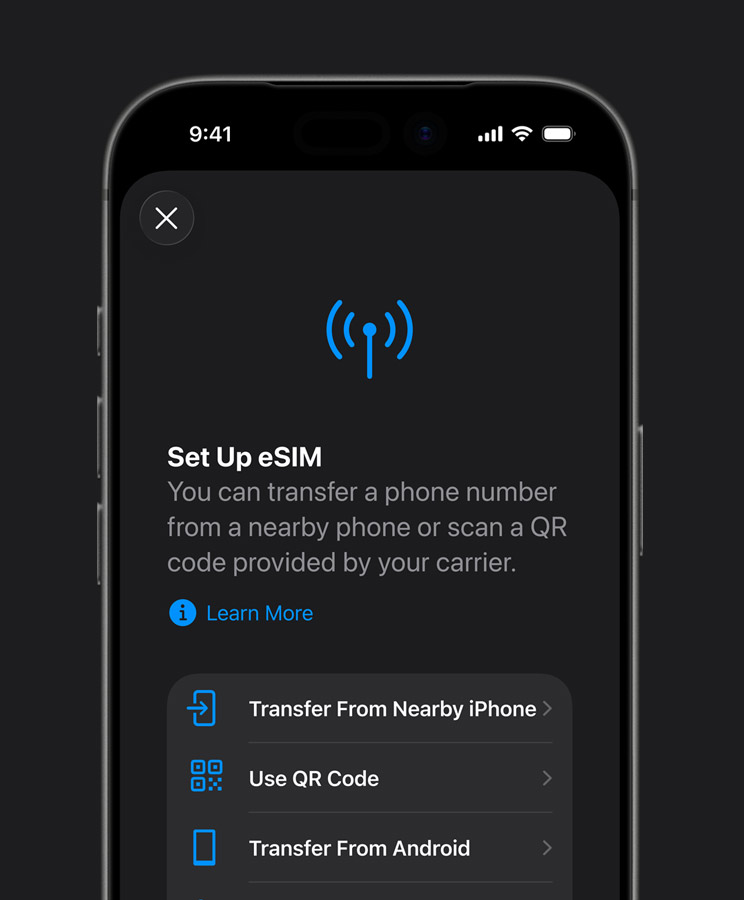
In the USA, Mexico, Canada, Japan, and a few other countries, all iPhone 18 Pro models are eSIM-only.
The iPhone 18 Pro, however, still has physical SIM slots in Europe and most other international markets - and it sacrifices a bit of battery capacity to the space taken up by the SIM slot.
The iPhone Duo is eSIM-only worldwide, like the iPhone Air.
International Models Remain Limited, No mmWave or 600 MHz Cellular!
Despite the C2 modem being identical across most markets, Apple has not released a universal global model of the new iPhones.
In particular, Apple has retained mmWave 5G support as an exclusive capability for phones destined for the USA.
Ultra-high-frequency mmWave 5G signals enable amazingly fast performance, but the signal is exceedingly short-range and requires specialized antenna modules to receive. To date, it has not been deployed much internationally, and it seems that even though the C2 modem now supports mmWave, Apple is saving on the cost of the specialized mmWave antennas on the international models.
The international iPhone Duo and 18 Pro Max variants will be mostly identical to the USA version, other than some minor differences in cellular and battery capability:
- Canada / Mexico / USVI / Japan / Middle East Model - Lacks all mmWave bands (n258 / n260 / n261) and adds Japanese 4G bands 11 and 21. This model is eSIM-only, dropping the physical SIM slot like the USA version. These versions support n71 and n14.
- Other International Models - All the various other international models lack mmWave bands and also lack 600 MHz n71 and b71 (T-Mobile's long-range coverage) and AT&T FirstNet (Band 14 and n14), as well as some other minor 4G and 5G bands.
The lack of mmWave support is a minor consideration for Canadians who travel to major US cities, where this sort of coverage might make a difference.
Those who spend a lot of time in the USA should avoid all other international iPhone 18 Pro and iPhone Duo models, as they lack support for the 600 MHz bands critical for use on T-Mobile and the FirstNet band 14/n14, which is exceedingly valuable on AT&T.
It is unclear why Apple has not made support for these bands more universal.
Satellite Connectivity Remains Free, Unchanged
Just like with every iPhone since the iPhone 14 in 2022 - the iPhone Duo and iPhone 18 Pro lineup comes with built-in and seemingly unchanged satellite messaging support.
Apple promises two years of free satellite access - and since Apple has still not figured out what to charge for satellite messaging and emergency SOS features, they are granting another year of free service to people who already purchased older models:
"Apple is extending free access to satellite features for an additional year for existing iPhone 14, iPhone 15, and iPhone 16 users. The free trial will be extended for iPhone 14, iPhone 15, and iPhone 16 users who have activated their device in a country that supports Apple’s satellite features prior to midnight PT on September 9, 2026.
Maybe someday Apple will start to charge for satellite features, but they have once again punted that decision at least another year down the road.
This is Apple's own satellite service, using legacy Globalstar satellites, which are independent from carrier-provided satellite capabilities like T-Mobile's T-Satellite With Starlink, which launched last year.
For T-Mobile customers, both satellite services can co-exist, providing extreme redundancy when you're way off-grid.
iOS 27, Connectivity Updates for Everyone
Even older iPhone models will be getting a connectivity upgrade on Monday, September 14th, when iOS 27 is released.
iOS 27 promises improved connectivity with "smarter transitions between Wi-Fi and cellular networks" - hopefully at last resolving the frustrating drops that come about when walking away from your home or work Wi-Fi zones before cellular kicks in.
Also new in iOS 27 is an iPhone Handoff feature that lets two iPhones share a single eSIM so they can both accept incoming calls to the same number. I suspect Apple wants to make it easy for people to leave their expensive iPhone Duo at home and take their old beater out when doing rougher activities....
iPhone Handoff requires carrier support and will be supported first by T-Mobile in the USA.
Concluding Thoughts

The big mystery this year - why did Apple keep Qualcomm around for only one model - in only one country?
Odds are it was just Apple hedging their bets - keeping a Qualcomm design in the works in case there were any issues with the C2.
Whether there is any performance difference or battery-life impact will be interesting to see once hands-on reports start rolling in. The iPhone 18 Pro with C2 versus the 18 Pro Max with Qualcomm will make for a natural comparison platform.
If Apple has managed to achieve parity with 5G cellular king Qualcomm, that is a truly impressive achievement - and it bodes well for future C-series modems.
As is the case every year, carriers and Apple will offer promotions for the new iPhones. Those interested in upgrading should do their research and carefully review the fine print.
Most promotions require you to turn in an existing phone and/or agree to a service commitment to "pay" for the phone through monthly bill credits. We don't track these sorts of deals here.
In short, carriers intend to entice you to make a long-term commitment to their service in exchange for a free or discounted iPhone.
Make sure you know what you are getting into (and that you are not agreeing to have your phone SIM locked to just one carrier!) - especially if you are the sort of geek who likes to upgrade every year or two.
Past iPhone Model Analysis:
Related Guides & Content:
- 5G Cellular Fundamentals for Mobile Internet - Our featured guide will help you understand what 5G is all about.
- 5G Cellular Resources - All of our guides & articles tracking 5G.
- Ways to Use Cellular Data To Get Online: Mobile Hotspot, Smartphone or Router?
- Smartphone Selection Tips
- Understanding LTE Modem Specifications (MiFi, Jetpacks, Routers, Phones)
- Cellular Evolution: 2G Thru 5G, And Beyond!







 Mobile Internet Resource Center was founded by Chris & Cherie of