

Key Points:
- Amazon is going to fall FAR short of its deadline to have launched half of the Amazon Leo constellation.
- Amazon has been asking the FCC for an extension, and that has at last been granted.
- The license extension comes with a big catch attached...

When the Amazon Leo constellation was first announced in 2019 (then known as 'Project Kuiper') - Amazon filed with the FCC to receive permission to operate a constellation consisting of 3,232 satellites.
When the FCC granted the license the following year - it granted Amazon valuable spectrum priority rights to operate these satellites.
But (as is typical with satellite licenses), to prevent squatting on spectrum rights that other satellite operators might potentially want to use - there was a deadline.
Amazon was legally obligated to deploy half of the Amazon Leo constellation (1,616 satellites) by July 30, 2026 - and the full constellation by July 30, 2029.
Back in 2020 this seemed like a reasonable deadline - and Amazon booked rides on a wide range of launch providers to get Leo into space with (theoretically) plenty of time to spare.
But things have not gone according to plan.
As of today, Amazon has launched 331 Leo satellites across 12 launches — far short of the FCC milestone deadline and putting the future of the Leo constellation at risk.
As we discussed in our satellite industry update story last week - Amazon has filed for a two year extension, and it was awaiting word whether the FCC would grant it a reprieve.
Without a ruling from the FCC - Amazon would not be allowed to launch ANY more Leo satellites after July.
The FCC has finally ruled...
Table of Contents
Amazon Leo FCC Video
Amazon’s Leo License Extension
SpaceX had been lobbying the FCC to crack down hard on Amazon, hoping to free up spectrum priority rights for additional Starlink satellites.
But the FCC seems to like there being two major satellite internet competitors - on Friday issuing a ruling waiving the July deadline and opening the door to Leo's continued deployment:
"Waiver serves the public interest by promoting a second large satellite broadband constellation.
At this time, only one operator, SpaceX, is providing broadband to American consumers from low-Earth orbit. Amazon Leo’s service promises to be “groundbreaking,” both in quality of service and affordability for consumers. Amazon Leo has further invested significant resources into meeting its commitments, including more than $10 billion to deploy the system along with investments in physical infrastructure and manufacturing capabilities. In this case, strict adherence to the rules would curtail Amazon Leo’s deployment of its Gen1 constellation by limiting the service it can provide to American consumers. Such would be contrary to the Commission’s mandate under the Communications Act, which requires that the Commission grant licenses that serve the public interest, convenience, or necessity.”
But there is a catch - all Amazon Leo satellites launched after the July deadline will "temporarily" lose their spectrum priority status - potentially impacting Leo's overall performance under certain circumstances:
"Specifically, we impose upon Amazon Leo meaningful conditions that incent the company to continue deploying satellites at a rapid clip by temporarily demoting the spectral priority of satellites launched after the relevant July 2026 milestone deadline."
The Leo satellites will regain their priority status as soon as Amazon reaches the 1,616 launched mark.
Or priority will return on October 30th, 2027 if Amazon can certify that 1,616 Leo satellites have been constructed by that date - even if they are not launched yet.
This extension should hopefully buy Amazon enough runway to get the Leo constellation well on the way to being fully deployed.
Amazon is still legally on the hook to have launched all 3,232 Amazon Leo satellites by July 2029.
Concluding Thoughts
Things have been pretty wild in the buildup to Amazon Leo's commercial launch - which Amazon is still claiming will happen later this year.
The big news is the explosion of Blue Origin's New Glenn, taking away Amazon's most ideal option for getting Leo satellites a ride to orbit.
Also underway - Amazon's acquisition of GlobalStar (see our story), which is also now going through FCC review.
But Amazon is pushing ahead with other launch providers.
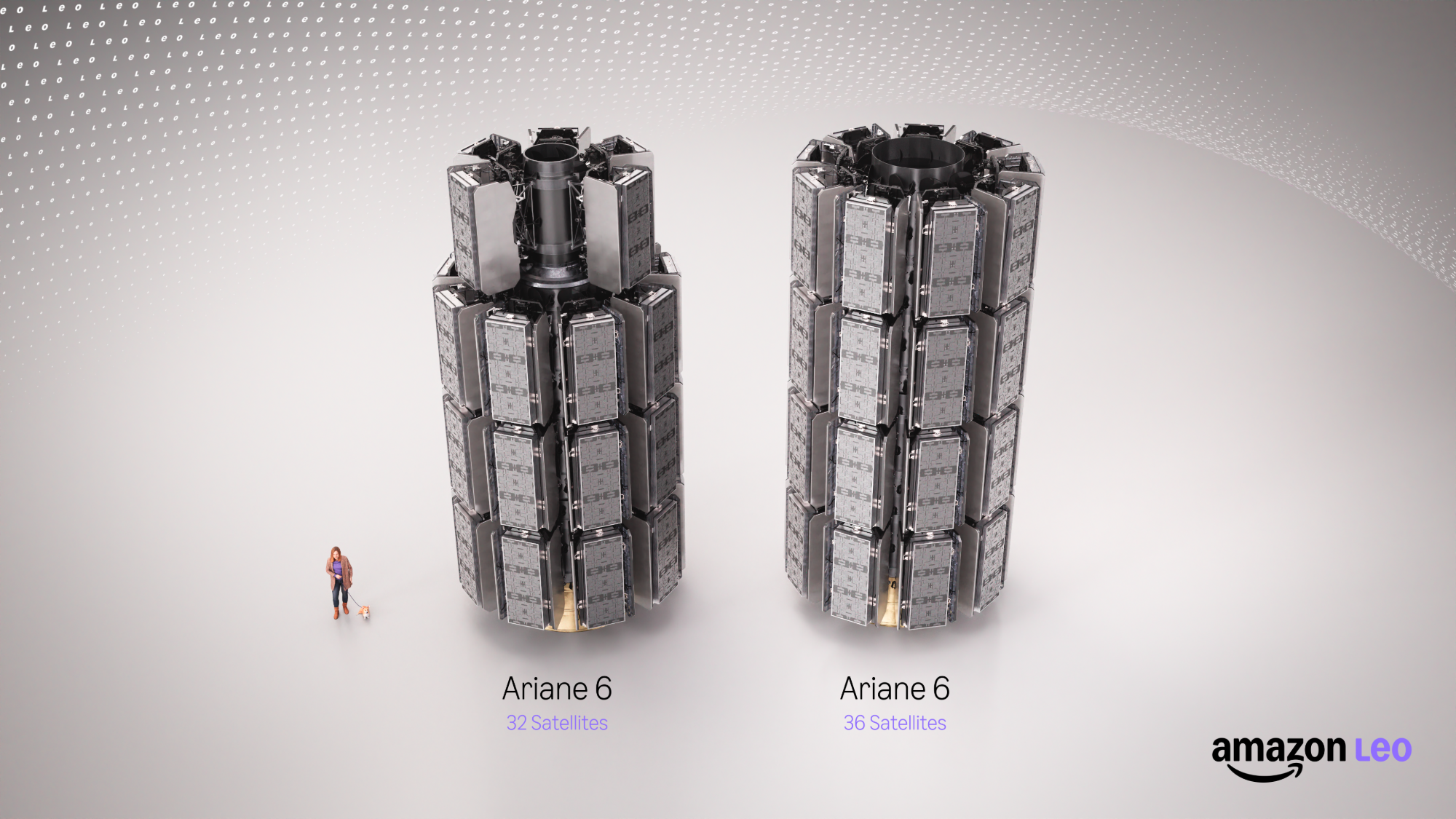
The next Amazon Leo launch will be 36 satellites on an Arianespace rocket launching on June 17th. This is Amazon's third launch with European launch provider Arianespace.
With New Glenn and ULA's Vulcan out of commission - Ariane and SpaceX's Falcon will have to pick up the slack to keep Leo on track.
A wild ride ahead!
ATTENTION MIA MEMBERS:
A lot has been happening on the satellite internet front lately. We'll be discussing the latest news and the impacts on Amazon Leo, AST SpaceMobile, and SpaceX's Starlink on our next MIA exclusive webinar on Tuesday, June 9th at 7pm eastern. Join us!
Further Reading
- Mobile Satellite Internet Options -
 Our featured guide on all the current and future satellite internet options of interest to RVers and cruisers.
 - All our Satellite Internet Resources - Our collection of guides, gear center entries and news coverage on satellite internet.
- Satellite Internet Industry Update: Mid 2026 Satellite Mobile Internet Update: New Glenn Explosion Derails Amazon Leo & AST SpaceMobile, SpaceX Begins Starlink V3 Testing
And here is all of our latest satellite internet coverage:







 Mobile Internet Resource Center was founded by Chris & Cherie of