
Key points:
- Starlink has officially released its new V5 dish - now available in select areas.
- The V5 is much smaller, lighter, and more power-efficient than the current Standard V4 dish.
- Starlink appears to have dropped the "Standard" branding and is simply calling the new hardware Starlink V5.
- Starlink lists slightly lower peak speeds for the V5 than the Standard V4.
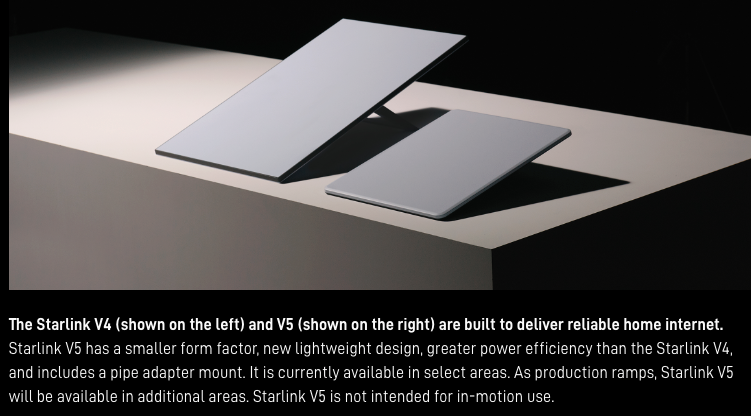
- Starlink says the V5 is NOT intended for in-motion use.
The Starlink V5 dish has officially appeared on Starlink’s website after first being teased over a month ago when Elon Musk briefly showed it off during an interview leading up to the SpaceX IPO.
At the time, not much was shared about the new hardware beyond saying that it was designed to allow SpaceX to dramatically ramp up Starlink hardware production.
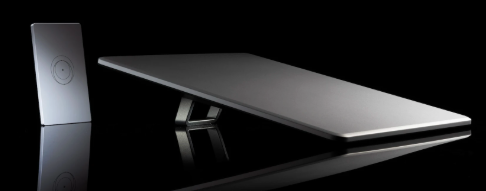
But the one thing that was obvious at first glance was that the V5 dish would be MUCH smaller than the current Standard V4 dish.
Now that the Starlink V5 has officially appeared on Starlink’s website, the remaining specifications have at last been revealed.
And those details reveal an interesting story - with a V5 design that may be two steps forward and one back.
Table of Contents
Starlink V5 Video
Starlink V5: A Smaller And More Power Efficient Dish
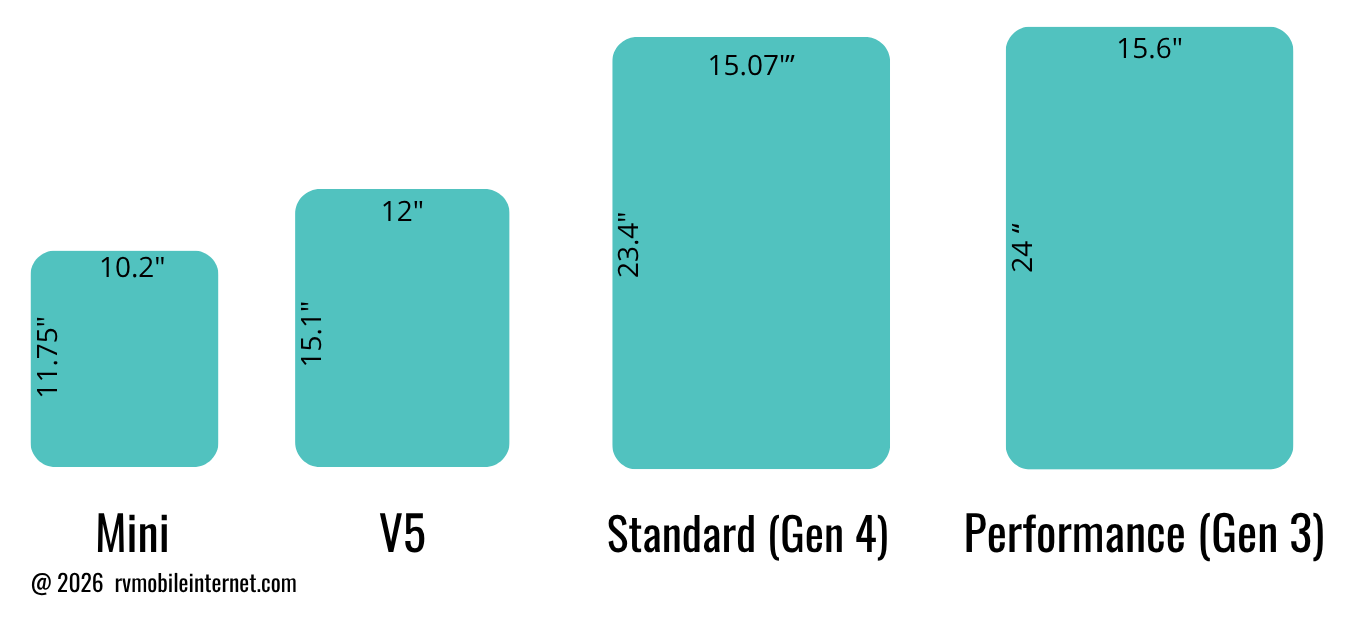
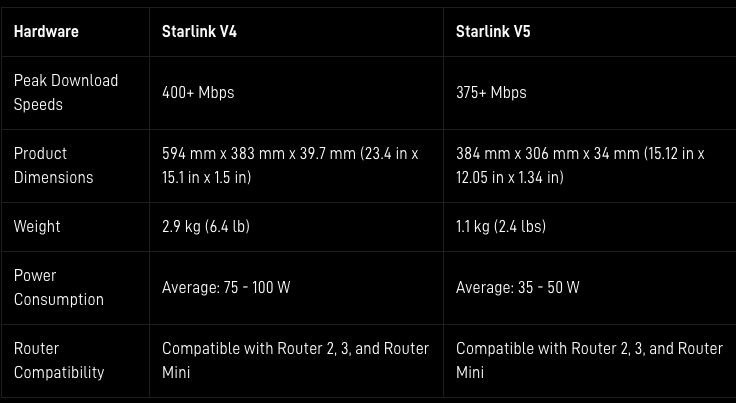
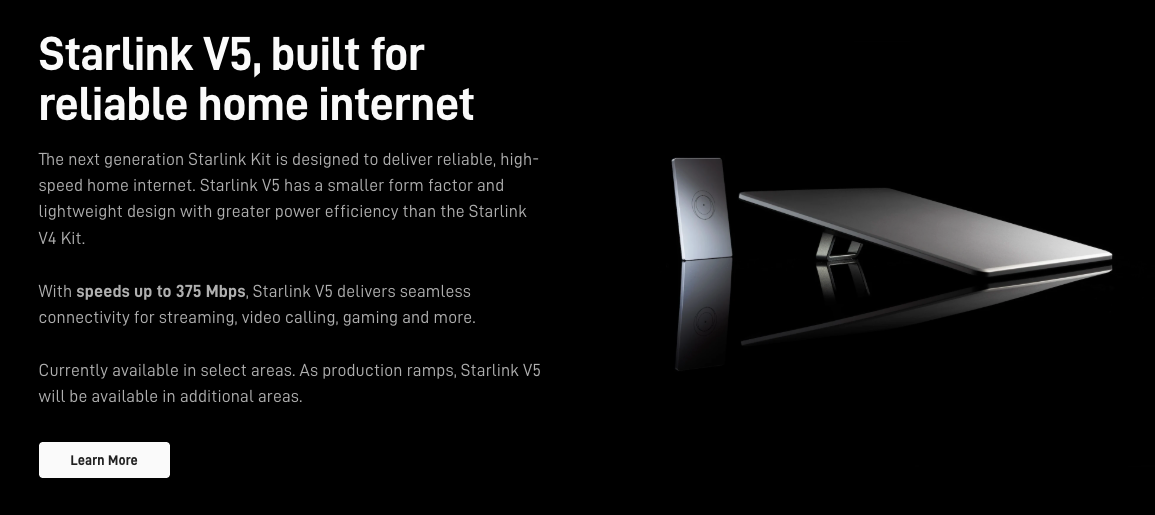
The biggest change with Starlink V5 is obvious at first glance: Starlink has significantly reduced the dish size compared to the current Standard V4.
The V5 is not quite as small as the Starlink Mini, but it is much closer to Mini territory than it is to the current Standard V4.
Even more surprising, the V5 dish itself weighs about the same as the Mini dish, coming in at just 2.4 lbs.
 Power consumption is also much lower. Starlink lists the V5 as using 35-50W, compared to 75-100W for the current Standard V4.
That is a big drop on paper, and we know from real-world experience that the Standard V4 often uses noticeably less power than Starlink's published range. We will have to wait for real-world testing to know for sure how the V5 actually performs.
Lower power consumption is always welcome for RVers, boaters, and off-grid users who run Starlink on batteries. But that does not necessarily mean this dish is aimed at the mobile audience.
In fact, we found some surprising details that make us question just how mobile-friendly this new hardware really is.
One other detail worth pointing out is that Starlink appears to be retiring the "Standard" branding - calling this new hardware simply "Starlink V5" rather than "Standard V5."
So Is Starlink V5 Really Not Built For Mobile Use?
While the Starlink V5’s smaller size, lighter weight, and lower power consumption all sound great for the average nomad trying to stay connected on the road, Starlink’s own support documentation has one big catch: it says that the V5 is NOT intended for in-motion use.
That leaves us scratching our heads a bit, because the V5 seems to be a natural fit for mobile installations - and the spec sheet even lists a mounted wind rating of up to 165 mph, which is significantly higher than the 60 mph+ rating listed for the current Standard V4 and Mini dishes.
Of course, wind resistance and approved in-motion use are not the same thing.
A dish may be able to handle high winds when properly mounted, while still not being designed, tested, or approved for use while a vehicle is actually moving. And we don't see a specific FCC approval for this dish, suggesting it may be covered by an existing blanket approval.
Starlink’s home page also describes the Starlink V5 as “built for reliable home internet” and mentions nothing about mobile users.
That could change in the future, but for now, the V5 does not appear to be an immediate replacement for the Standard V4 hardware that Starlink recently removed as an option for new Roam plan orders.
For new mobile Starlink Roam plan users, the hardware choices appear to be the Mini or the pricey Performance dish - at least for now.
The V5 Does Not Appear To Be A Speed Upgrade
The smaller size and lower power consumption are nice improvements, but Starlink does not seem to be targeting improved performance with the V5.
In fact, the V5 may be slower than the Standard V4!
In Starlink's own comparison table, the Standard V4 is listed with peak download speeds of 400+ Mbps, while the new V5 is listed slightly lower at 375+ Mbps.
Under the hood, some online engineering analysis shows that the V5 has 820 antenna elements in its phased array, barely half the 1536 elements in the Rev 4.
It seems clear that the primary design goal for the V5 was lowering production cost - not pushing performance levels.
But the real-world difference is likely to be unnoticeable. And it is probably not something most users should obsess over.
Starlink speeds vary widely depending on location, network congestion, obstructions, and the service plan in use. Slightly lower peak theoretical speeds are not really something to worry about.
Unless hands-on testing reveals otherwise, it is likely safe to assume that the speed regression in the V5 will be unnoticeable.
But for those hoping the next generation of Starlink hardware would bring a major speed boost in preparation for the capabilities in the upcoming next-generation V3 satellite constellation, the V5 is not that upgrade.
Inside The Starlink V5 Kit
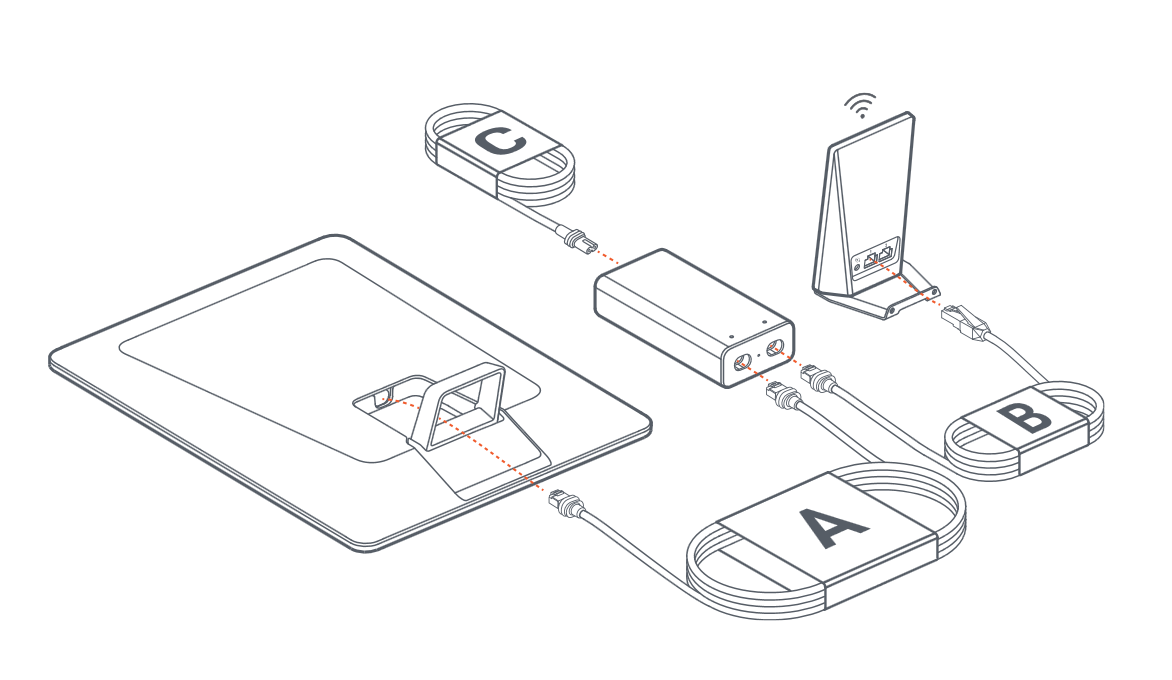
The Starlink V5 kit includes the dish, removable kickstand, pipe adapter, separate power supply, Router Mini, Router Mini stand, Starlink cable, Ethernet cable, and power cable.
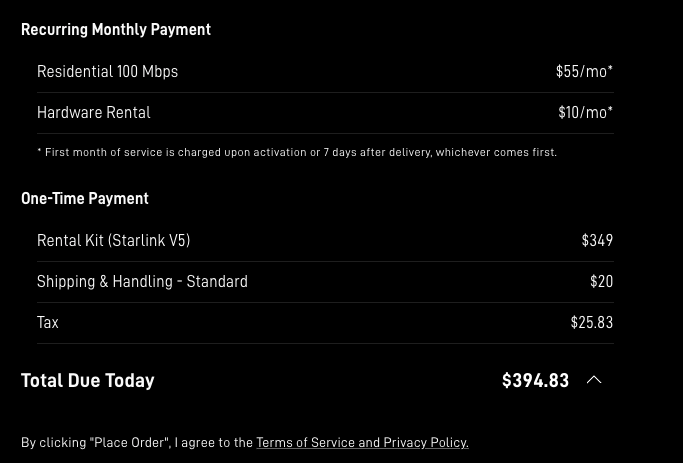
Based on the current Starlink ordering flow we checked, the V5 appears to replace the hardware option for the lower-tier Residential 100 plan, while the larger Standard 4X remains the hardware option for the higher-tier Residential 200 Mbps and Residential Max plans.
Pricing is a little confusing so far. In the Boise, Idaho, ordering flow we checked, the V5 showed as a rental option with a $349 upfront hardware charge, while Starlink also still appeared to be applying the $10/month residential rental fee. That could be intentional, or it could simply be an early website rollout issue, which would not be unusual for Starlink.
For now, we do not read too much into the early pricing and availability details, especially since Starlink says the V5 is only available in select areas.
The included Router Mini is smaller and less capable than Starlink's larger routers, but it still supports Wi-Fi 6 and includes two 1 Gbps Ethernet ports. For many basic home users, that will likely be enough, especially since coverage can be expanded with additional Router Minis.
The nice thing Starlink retained with the V5 is a separate power supply. The power supply connects directly to the dish, then to the Router Mini via the included Ethernet cable, powering both with PoE (Power over Ethernet). This means the Starlink router is not required to power the dish, making it easier to use your own router or network setup if you prefer.
This matters for more advanced users who already have a better router, mesh system, or mobile router they would rather use with Starlink.
The included pipe adapter is also a nice addition. Anyone who already has a Starlink mounted on a pole or pipe-style mount may have an easier time adapting the V5 without immediately needing to purchase extra mounting hardware.
Conclusion - Not The Roam Replacement Some Were Hoping For
For RVers, boaters, and other mobile users, the Starlink V5 is both interesting and a little frustrating.
On paper, this is the kind of hardware many mobile users would like to see from Starlink.
The V5 is smaller, lighter, more power-efficient, includes a separate power supply, and still makes it easy to use your own router or networking gear.
But at least for now, Starlink seems to be treating the V5 as fixed-location home internet hardware only, not as the new Standard V4 replacement for Roam plans.
That means the V5 does not immediately solve the gap created when Starlink removed the Standard V4 from new Roam plan orders. For new Roam users, the choices still appear to be the Mini for portable use or the Performance hardware for higher-end/in-motion use.
That could still change as Starlink expands availability and updates its ordering flow.
But at launch, the V5 does not look like the immediate Standard V4 replacement on Roam that many mobile users were hoping for.
We suspect a new-generation Starlink Mini may be in the pipeline as well - in the interview where the V5 was first glimpsed, a new Mini design was also seen sitting on the table.
As always with Starlink - the only constant is change!
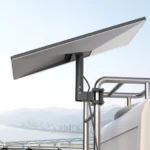
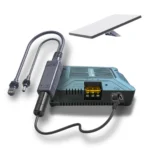
Starlink Accessories from MobileMustHave
Check out these Starlink accessories sold by our friends at MobileMustHave:


Learn More:
Starlink's Referral FAQ.

Use our referral link when purchasing equipment from Starlink.com and activating a consumer Residential or Roam data plan - and get a FREE month of service!
Someone on our team will also get a service credit, which helps us keep our multiple lines of service active for continued testing.
It's a win-win - you save money and help support MIRC!
Further Reading
- Starlink Satellite Internet For Mobile RV And Boat Use - Our featured guide focused on taking advantage of SpaceX's Starlink on the go.
- Mobile Satellite Internet Options;-
 Our featured guide on all the current and future satellite internet options of interest to RVers and cruisers.
 - All our Satellite Internet Resources - Our collection of guides, gear center entries, and news coverage on satellite internet.
- Industry Update: Mobile Satellite Internet for RVers & Boaters - Our deep dive into the current state of the satellite internet world.
And here is all of our recent satellite internet coverage:





 Mobile Internet Resource Center was founded by Chris & Cherie of