
Key points:
- Starlink is testing dynamic pricing for Residential plans in select US markets, with monthly rates varying up to +/- 20% based on local demand and capacity.
- Demand surcharges for Residential service in many areas have been reduced or eliminated.
- Starlink notified priority customers of plan changes coming December 1st, including a 50% increase in data costs for the Global plan.
- Global Priority plan will be renamed to "Global Business," and Local Priority will be renamed to "Business."
- The Local Priority (Business) plan will also receive a reduction in international use from 60 to 30 days.
Starlink is making another round of pricing and plan changes, and this time two very different groups of customers are affected: Residential subscribers in select locations, and Priority subscribers who need higher-priority service or connectivity on the open ocean.
For Residential customers, Starlink is testing dynamic pricing in parts of the Midwest, which could roll out to other areas or perhaps go nationwide.
Meanwhile, Priority plans are being renamed, and customers on Global Priority are being notified of substantial data-price increases effective December 1, 2026. Local Priority is not getting price increases but is seeing international usage drop from 60 to 30 days.
Let's dig into the details and implications of these changes...
Table of Contents
Video Story
Coming Soon!
Starlink Tests Dynamic Residential Pricing
Starlink has begun emailing Residential customers in select US markets about a new dynamic pricing system.
Instead of one consistent monthly rate for each Residential tier, prices are being adjusted according to local network capacity and customer demand.
The initial reports are concentrated in the Midwest, particularly Missouri and Kansas, and we have verified these changes are live on Starlink's website in several areas of those states.
So far, it looks like pricing varies by up to 20% either up or down from the base Residential plan price, and this affects both Residential MAX as well as the 100 Mbps and 200 Mbps options.
Effectively, this creates five pricing tiers:
Many higher-congestion areas are still only offering Residential MAX - whether the 100Mbps and 200Mbps plans are offered still varies by location.
Here are some screenshots of Starlink's website from locations in Missouri showing that dynamic pricing is currently active for new signups:
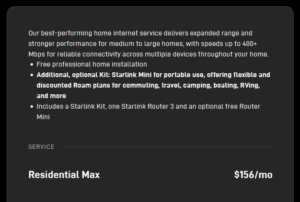
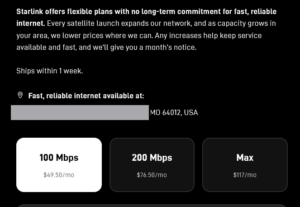
Some existing customers have been told their prices are increasing, while others are decreasing, depending on location.
However, Starlink has not announced that 20% is a permanent limit on future changes.
More significantly, Starlink's emails say it expects to review prices approximately every three months as the satellite constellation expands and subscriber demand changes.
That does not mean everyone's bill will change every quarter, but it does introduce the prospect of much more frequent price adjustments than Starlink Residential customers have been accustomed to.
Starlink has adjusted Residential rates based on network capacity in the past, including different prices for high- and low-capacity areas in 2023.
This new approach, assuming it gets rolled out to the rest of the US in the future, appears to be a more systematic version of that strategy, now applied across all the three Residential tiers.
It also comes just months after Starlink raised US Residential, Roam, and Standby Mode prices in May.
Demand Surcharges Changing
Along with the dynamic pricing test, Starlink has also been reducing its one-time demand surcharges in some congested areas, although they remain in effect.
In our recent checks of addresses around Seattle, Residential Max was available at the standard $130/month, but with a $500 demand surcharge. In nearby Enumclaw, the surcharge was $250.
These charges were previously as high as $1,000 in parts of the Pacific Northwest, and reached $1,500 in Alaska earlier this year. High-congestion areas in Alaska also appear to have been reduced to $500.
Assuming the dynamic pricing rolls out to the rest of the US, it's not yet clear how it will be implemented in areas that have long had demand surcharges.
Also, as we reported back in April, Starlink altered its address-change terms so that customers who change their address to a location with a demand surcharge will have to pay the surcharge - a big potential surprise and danger for nomads using Residential as a portable option. That policy remains in place.
Impact on Mobile Users Who Use Residential Plans

Residential service is officially intended for use at a fixed registered service address, but many nomads have long used a Residential plan while changing the service address at each new travel location.
This has long been an attractive option for those who want unlimited data and higher network priority at a lower monthly cost than Roam Unlimited (currently priced at $175/month).
But it has also become more complicated as Starlink has tightened plan availability and made other changes.
Dynamic pricing adds to that complication, but the potential benefit is lower prices in many more isolated areas where nomads may travel.
So far, Starlink's terms for address changes remain the same - you can change addresses often, as long as there is availability. What's unclear is how dynamic pricing will work when changing mid-cycle, including prorating, and how the new local rate will apply to an existing subscription after an address change.
Priority Plans Renamed, Pricing and Term Changes
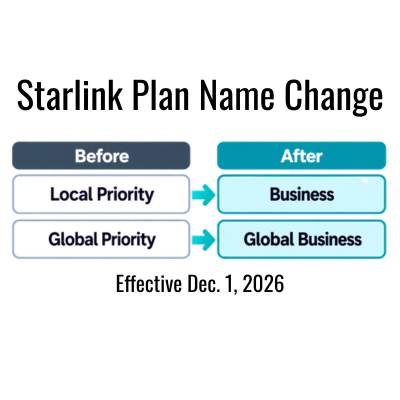 Separately, Starlink is notifying Priority customers of changes taking effect December 1, 2026.
The existing Local Priority and Global Priority plans are being renamed "Business" and "Global Business," respectively.
However, there are also some important plan changes that come with these new names:
Global Priority/Global Business Data Prices
We have received copies of Starlink customer emails confirming that US Global Priority (soon to be Global Business) data blocks will increase in price by 50%, while the monthly terminal access charge will remain the same.
Global Priority is Starlink's plan for higher-priority connectivity worldwide, including open-ocean use - without out-of-country location restrictions. It charges a monthly terminal access fee plus a required purchase of data in blocks, rather than providing unlimited high-speed data.
The terminal access fee is remaining unchanged at $150/month, however, the data block prices are increasing as follows starting on December 1st:
- 50GB - $150 (up from $100)
- 500GB - $750 (up from $500)
With the terminal charge, the minimum plan price for Global Priority/Global Business will be $300/month for 50GB of data.
These figures apply to US-registered accounts - rates and changes in other countries can differ.
Local Priority/Business International Roaming Reduction
According to emails customers have received, prices for Local Priority/Business plans are not changing on December 1st, but international roaming is changing.
Business will allow only 30 consecutive days of international use, reduced from 60 days under Local Priority.
Global Business does not have this 30-day limit, but it is now much more expensive.
Note that Starlink treats the United States and Canada (including associated territories) as a single service region (but Mexico and the Bahamas are excluded), so travel between the US and Canada does not use the international allowance, as it is considered one "domestic" region.
The other major region covers most of Europe, which benefits Europe-based accounts.
Priority Plan Change Impacts
The Global Business price increase and reduced international use for Local Priority/Business are particularly significant for the boating community, but they also affect many land-based nomads who travel internationally, especially seasonal travelers in Mexico.
Starlink has become a key connectivity option for long-distance cruisers, and accessing service beyond coastal waters requires a plan or add-on that specifically permits water and ocean use. These latest changes come on top of a series of major plan revisions over the last two years, which we've covered extensively:
- In March 2025, Starlink overhauled its Priority lineup, introducing Local and Global Priority with separate access fees and data blocks, while eliminating the previous unlimited high-speed data after the included priority allowance was exhausted.
- In July 2026, Starlink substantially tightened international roaming, limiting Roam Unlimited to 30 days abroad at a time and restricting the capped Roam plans to the home country or grouped service region.
- In August 2026, Starlink introduced Personal Maritime at $185/month for qualifying recreational vessels, with unlimited data in territorial waters and no Roam-style 30-day international limit. But it also tripled the cost of Ocean Mode data from $2/GB to $6/GB.
- In September, Starlink relaxed Personal Maritime's vessel-length guideline from 40 feet to 60 feet after considerable concern from cruisers. The plan still has eligibility requirements and prohibits use on land.
The new Global Business pricing makes another ocean-capable option significantly more expensive.

A full-time ocean cruiser using 500GB of Global Priority data will see the monthly price rise from $650 to $900 - a $250/month increase.
But the effects are not limited to people crossing oceans.
Even a relatively short passage from Florida to the Bahamas, or between Caribbean islands, may cross waters more than 12 nautical miles from shore. Starlink treats those areas as open ocean, where ordinary Roam or Personal Maritime coverage is not sufficient. For these passages, boaters generally have two ways to maintain Starlink service offshore:
- Roam Unlimited or Personal Maritime with Ocean Mode: Ocean connectivity costs $6 per GB on top of the underlying monthly plan. Ocean Mode must be enabled and stays active until you manually turn it off, including after a vessel returns to coastal waters. All data used while it is enabled is billed at that rate.
- Note that Starlink's Roam plans, including Roam Unlimited, remain limited to five consecutive days or 60 total days annually in territorial waters without Ocean Mode.
- Global Business: Starting December 1, the entry-level US cost will be $300/month for 50GB of priority data, with larger or additional blocks available at the new prices. This provides ocean-capable data without the per-GB Ocean Mode charge.
Which option costs less will depend heavily on how much data is used offshore and how long the vessel remains away from its home country.
Before this round of price increases, it made sense to switch to Global Priority if you expected to use more than about 10 GB of Ocean Mode data in a month.
But soon Global Business will cost $300/month for 50GB of data, up from $250 under the previous Global Priority pricing. At the unchanged $6/GB Ocean Mode rate, Personal Maritime customers would need to consume approximately 20GB of Ocean Mode data before Global Business becomes less expensive.
For Roam Unlimited users using Ocean Mode, the break-even point is approximately 21GB.
However, this comparison assumes Global Business users stay within the 50 GB monthly data allowance after switching.
Since Personal Maritime includes unlimited data in territorial waters, cruisers who consume substantial data while anchored or docked after a crossing may find it less expensive to use Ocean Mode data, even when their offshore usage exceeds these break-even points.
In short, whether to switch and how to organize your Starlink service as you travel can get very complicated.
Land-Based Nomads Also Affected

For land-based travelers, the reduction in international usage from 60 to 30 days on Local Priority/Business is particularly significant for land-based nomads who spend extended periods outside their home country, particularly snowbirds and seasonal travelers in Mexico, which is not included in the domestic region that includes Canada and the US.
It also removes the middle option for people who need 31 to 60 days abroad. Previously, a traveler could spend 30 days abroad on Roam Unlimited and upgrade to Local Priority for another 30 days (Starlink explicitly said those allowances were shared, not reset, when switching plans).
Starting December 1, both Roam Unlimited and Business will have the same 30-day limit, leaving a few options for those needing more than 30 days:
- Return to the US every 30 days - This resets the international allowance, but is impractical for many travelers far from the border or on extended travels.
- Upgrade to Global Business - No international time limit, but it costs much more with data caps.
- Transfer service to a local account - Enables locally registered service, but involves account-transfer restrictions and administrative requirements. Other countries may offer different plans and pricing.
- Maintain a second Starlink on a local account- Potentially convenient for regular seasonal travelers, but requires additional hardware and a separate subscription.
- Use cellular or another connectivity option - Potentially a good, economical alternative or complement, depending on coverage and costs.
Concluding Thoughts
Starlink continues to expand capacity and offer impressive connectivity in places where fast internet was once difficult or impossible to obtain.
But its frequent changes to pricing, plan availability, and service rules make it increasingly complicated, expensive, and frustrating for users, particularly those in our audience of boaters and RVers.
Dynamic Residential pricing could benefit nomads who use Residential and spend most of their time in less congested areas, or penalize them if they travel in more congested areas.
For boaters and international travelers, it's bad news. The Priority plan changes are the latest in a series of changes that have systematically narrowed options for international travelers using Starlink.
Despite Starlink being a global network and system, the company continues to increase restrictions on international use - unless one is willing to pay a premium for the Global Priority/Global Business plan.
Personal Maritime helped address some of the international cruising community's concerns, but the $6/GB Ocean Mode rate and now higher Global Business prices make ocean passages even more expensive for those who desire more than a modest amount of data.
With no comparable land-based option to Personal Maritime, land-based international travelers have fewer and more expensive alternatives beyond 30 days outside their home country or region.
These changes reinforce an ongoing frustration with Starlink: Uncertainty.
With multiple plan and terms-of-service changes in a single year, compounded over several years, customers have to constantly reevaluate their connectivity strategy. This is particularly difficult and frustrating for many in our audience who are in the middle of extended travels, where it's not easy to make fundamental changes to their planned and needed connectivity options.
We'll continue monitoring the rollout of Residential dynamic pricing and how the December Priority Plan changes affect real-world use by RVers and cruisers, as well as report on future Starlink changes, which are sure to come.

Learn More:
Starlink's Referral FAQ.

Use our referral link when purchasing equipment from Starlink.com and activating a consumer Residential or Roam data plan - and get a FREE month of service!
Someone on our team will also get a service credit, which helps us keep our multiple lines of service active for continued testing.
It's a win-win - you save money and help support MIRC!
Starlink Accessories from MobileMustHave
Check out these Starlink accessories sold by our friends at MobileMustHave:



Further Reading
- Starlink Satellite Internet For Mobile RV And Boat Use - Our featured guide focused on taking advantage of SpaceX's Starlink on the go.
- Mobile Satellite Internet Options -
 Our featured guide on all the current and future satellite internet options of interest to RVers and cruisers.
- All our Satellite Internet Resources - Our collection of guides, gear center entries, and news coverage on satellite internet.
- Industry Update: Mobile Satellite Internet for RVers & Boaters - Our deep dive into the current state of the satellite internet world.
And here is all of our recent satellite internet coverage:








 Mobile Internet Resource Center was founded by Chris & Cherie of
