
Key points:
- SpaceX's Starship successfully reached orbit for the first time yesterday - a huge milestone in the Starship development program.
- This wasn't just a test flight - SpaceX brought along 26 Starlink V3 satellites, the first building blocks of the next generation of the Starlink constellation.
- SpaceX has already begun to wind down its Falcon 9 program - turning customers, competitors, and even NASA away to focus on Starship.
- SpaceX has announced plans to bring gigabit speeds to some Starlink customers later this year.
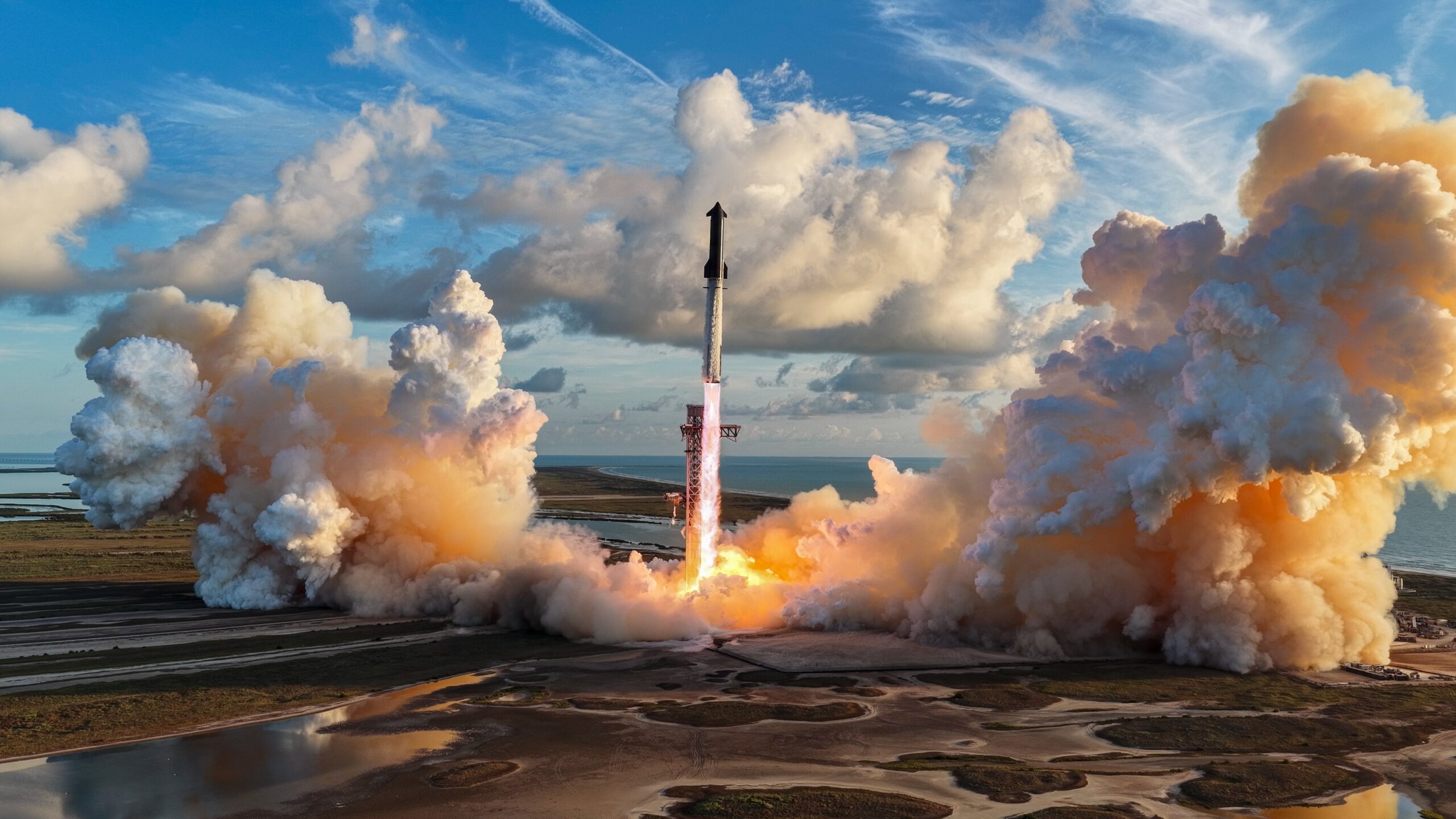
SpaceX is celebrating today after Starship's near-perfect first orbital mission yesterday morning, including the first orbital deployment of Starlink V3 satellites.
Starship is still a long way from being rapidly reusable like the Falcon 9 - but by proving that it can carry useful cargo to orbit SpaceX can begin putting each future Starship development flight to practical use by deploying more Starlink V3 satellites with each launch.
This is a major milestone in the history of spaceflight - and with launch competitors like Blue Origin and satellite internet competitors like Amazon Leo still struggling to get back on track after suffering some major setbacks, it seems like SpaceX is pulling even further and further ahead.
The timing was appropriate too - yesterday was the 18th anniversary of the first orbital Falcon 1 mission, the very first privately developed rocket to reach orbit. Since then SpaceX has gone from scrappy upstart to the dominant giant it is today.
We've got the latest on this next major milestone...
Table of Contents
Starship & Starlink Video Update
<coming soon>
Starship's 14th Test Flight - Orbit At Last!
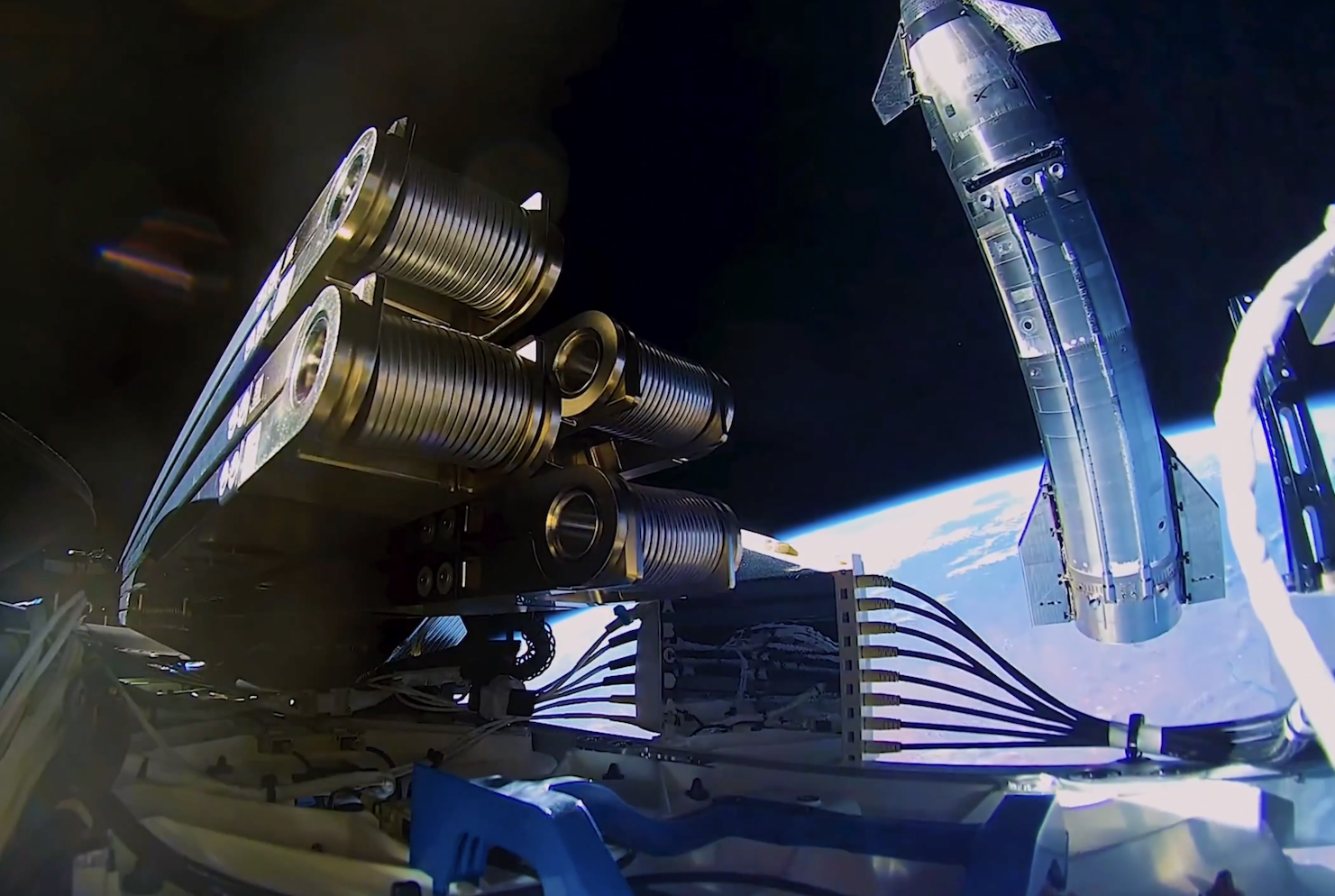
Just over a year ago SpaceX's 10th Starship test flight used dummy payloads to demonstrate the unique "Pez Dispenser" satellite deployment system designed for Starlink V3 - and it seemed that SpaceX would soon be ready to begin launching Starlink V3 satellites.
But it took a year and a few major stumbles to get the bugs worked out of the latest Starship design - with SpaceX needing to repeat several times the same suborbital flight path that had Starship landing in the Indian Ocean without reaching a useful orbit to deploy actual cargo.
Starlink V3 satellites were reportedly piling up in a warehouse in Texas waiting for an orbital ride.
SpaceX had so many excess satellites that it actually sent 20 along on Starship's 13th test flight on a suicide mission, proving out the deployment system and using the Starlink satellites to quickly take pictures of the Starship for analysis of the heat shield before their fiery demise just a few minutes later.
The 13th test flight went perfectly - so for the 14th flight, SpaceX felt confident that it could at last take Starship orbital - with 26 Starlink V3 satellites aboard this time!
Almost Another Suicide Mission
Despite starting off beautifully, yesterday's flight almost turned into another suicide mission.
One of Starship's six engines had a failure on the way to orbit - and even though the other engines automatically compensated to set up the preliminary suborbital trajectory perfectly, the risk that the failure might have damaged other engines had SpaceX initially planning to let the Starship proceed on a ballistic trajectory into the Indian Ocean - sacrificing the Starlink cargo and most of the mission objectives.
If Starship was allowed to proceed into orbit and it then had an issue that prevented a controlled de-orbit burn, the gigantic Starship would eventually come down in an uncontrolled fashion - potentially over a populated area.
SpaceX engineers had just 15 minutes to work through the issues to confirm they could do the final orbital insertion burn safely, and it was only at the last instant they made the call that Starship was a go for orbit.
With live HD views of Earth below (relayed through Starlink satellites, of course) - SpaceX completed two orbits and all 26 Starlink V3 satellite deployments.
The mission was initially slated to then coast for an additional 7 hours to test out longer-duration flight before a planned water landing off the coast of Chile.
But to be on the safe side - SpaceX cut the mission short to just two orbits instead of six, targeting a backup landing zone near Hawaii.
The re-entry was flawless - and Starship splashed down on target next to a camera-equipped observation buoy, before exploding (as expected) and sinking beneath the waves.
Other than a few minor glitches - overall the mission was a near-complete success.
Starship is now proven for orbital missions - and Starlink V3 satellites will likely be riding along on every development flight from here on out.
Starlink V3 - An “Insane” Upgrade
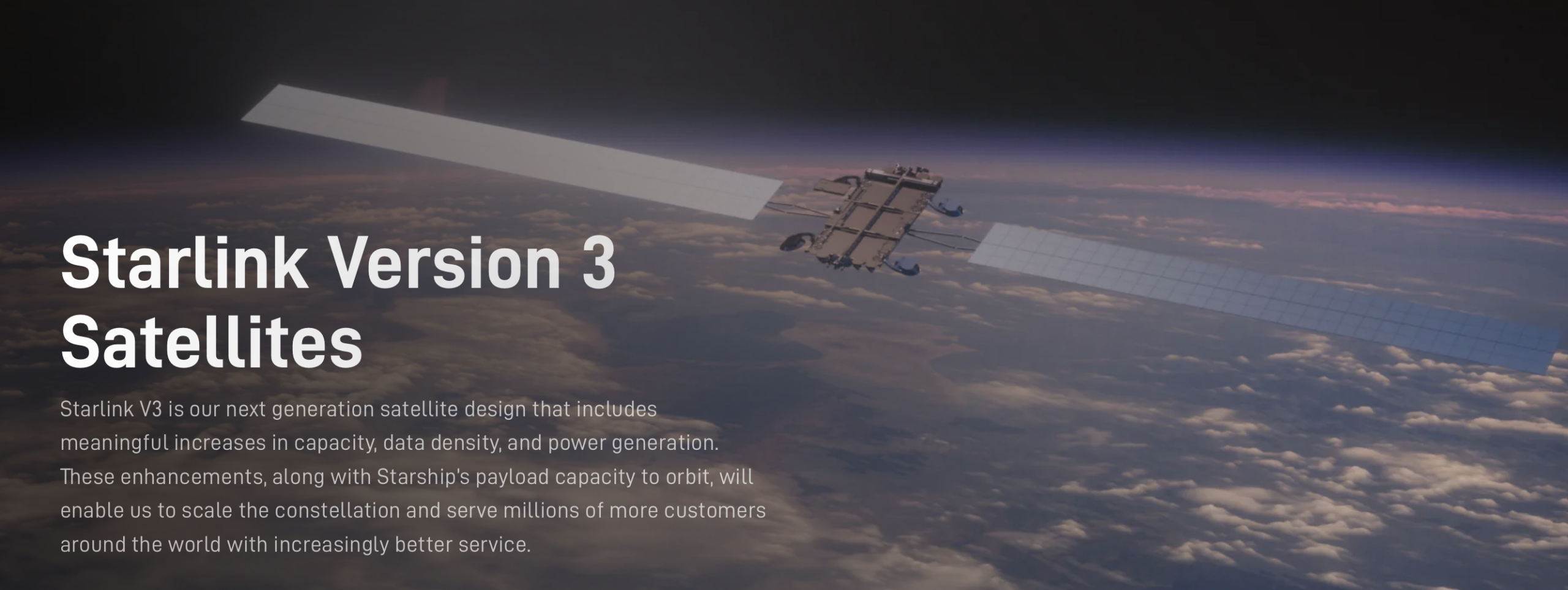
As a reminder, here are the known details of the Starlink V3 satellites' capabilities, compared to the current Starlink satellites.
The V3 satellites are physically larger (approximately 1,900 kg vs. 575 kg), and thus have more solar and computing power available.
Comparing the individual V3 satellites with the current V2 Mini satellites:
- Total User Downlink Bandwidth: 1 Tbps vs 96 Gbps
- Total User Uplink Bandwidth: 160 Gbps vs 6.7 Gbps
- Ground Station & Laser Interconnect Bandwidth: 4 Tbps vs 1.3 Tbps
Overall, this is 10x the downlink and 22x the uplink capacity of the V2 Mini Starlink satellites.
The number of users that can be served simultaneously by each satellite is increasing just as dramatically. SpaceX brags:
"The V3 satellite’s antennas support both 2,048 downlink and uplink beams. For comparison, Starlink V2 satellite’s phased arrays supported 192 downlink and 144 uplink beams."
Overall - the V3 satellites are a huge upgrade over the V2.
And since each Starship launch will eventually be able to carry up to sixty V3 satellites per trip, every launch will put as much as 20 times the bandwidth into orbit that a single Falcon 9 mission does.
And once Starship is fully reusable, a Starship launch should actually cost LESS than a Falcon 9.
The economics of Starship and the Starlink V3 satellites are the key to Starlink’s long-term evolution - and SpaceX has taken a major positive step in that direction.
Gigabit Starlink Speeds Coming - This Year?
The V3 satellites launched yesterday are just the start of what will become a massive network upgrade - adding a huge amount of performance and capacity.
During the SpaceX earnings call in August, Elon Musk said that a "critical mass" of probably around 1,000 Starlink V3 satellites would be necessary before the company could start offering speed increases - which he estimated could come "Approximately, second quarter of next year, would be where we'd get to that point."
But SpaceX has already updated the Starlink Business page to indicate that business and maritime customers in certain regions would soon be offered plans with dramatically increased speeds even sooner:
"Gigabit speeds available in 2026 - Starlink is focused on making network enhancements which will enable gigabit speeds starting in the most remote places on Earth with the Performance Kit. Service plan upgrades will be available in 2026. No hardware changes needed."
Gigabit speeds will require the $1,999 Starlink Performance system - and will likely roll out in limited areas at first.
No word yet on what plan pricing will be - but Starlink business customers are already bracing for price increases across the board.
Concluding Thoughts
With Starship now beginning to transition from a development program toward operational service, the economics of spaceflight are set to change dramatically - with the fundamental cost of getting cargo to orbit set to plummet.
But SpaceX seems to be focusing primarily on using Starship for Starlink launches, future AI orbital data centers, and government contracts.
Not (yet) on making Starship commercially available to others.
Meanwhile - SpaceX has made it clear that it is starting to wrap up its Falcon 9 program to focus on Starship.
SpaceX has already begun turning customers, competitors, and even NASA away from future launch contracts - sending other companies scrambling since most of the available commercial launch alternatives are delayed, grounded, and/or fully booked up.
With the Falcon 9 turning away customers and with Starship still in development with a backlog of Starlink V3 satellites in the pipeline - other satellite industry customers are not finding rides to orbit for sale at any price - and rather than falling, launch prices are actually climbing.
The next Starship flight seems to be on track for sometime in October - likely a near repeat of this mission.
After that - SpaceX is pushing towards beginning Starship launches in Florida before the end of the year, bringing another Starship launch location online to compliment Starbase, TX.
It is wild times in the space race - and at the moment, one company seems to be pulling way ahead...

Learn More:
Starlink's Referral FAQ.

Use our referral link when purchasing equipment from Starlink.com and activating a consumer Residential or Roam data plan - and get a FREE month of service!
Someone on our team will also get a service credit, which helps us keep our multiple lines of service active for continued testing.
It's a win-win - you save money and help support MIRC!
Further Reading
- Starlink Satellite Internet For Mobile RV And Boat Use - Our featured guide focused on taking advantage of SpaceX's Starlink on the go.
- Mobile Satellite Internet Options -
 Our featured guide on all the current and future satellite internet options of interest to RVers and cruisers.
 - All our Satellite Internet Resources - Our collection of guides, gear center entries, and news coverage on satellite internet.
- Industry Update: Mobile Satellite Internet for RVers & Boaters - Our latest deep dive into the current state of the satellite internet world.
And here is all of our recent satellite internet coverage:








 Mobile Internet Resource Center was founded by Chris & Cherie of