
Key points:
- The FCC has approved a new 15,000-satellite Direct-to-Cell constellation, a new and different constellation from the current Starlink system.
- The new system is intended to eventually provide broadband speeds to ordinary cellular devices like smartphones.
- Deployment is expected to begin in 2027, and depends on SpaceX's Starship to get the satellites into orbit.
- SpaceX is also buying more low-band spectrum - with plans to build a hybrid Starlink Mobile satellite/terrestrial mobile network that competes with traditional cellular carriers.
SpaceX's dream of becoming its own cellular carrier has taken a major step forward with FCC approval of a new constellation of 15,000 satellites designed specifically to connect directly to smartphones - and potentially other cellular devices like hotspots and cellular routers.
This new system is separate from SpaceX’s existing Starlink broadband satellites and the first-generation Direct-to-Device (D2D) system that currently enables T-Mobile’s T-Satellite service.
SpaceX calls the new satellites "V2 Mobile," and says they will dramatically increase the capacity and performance of satellite-to-phone service.
After the FCC approval, SpaceX also announced it was purchasing additional low-band cellular spectrum, filling a gap in its spectrum holdings that will help the future Starlink Mobile service better penetrate buildings and dense foliage.
How will this new system impact our audience of mobile users who live, work, or travel in vans, boats, or RVs?
Read on for details...
Table of Contents
SpaceX D2D Video
Coming Soon!
A Dedicated Direct-to-Cell Constellation
On October 6th, the FCC authorized SpaceX to deploy a new satellite constellation of 15,000 satellites in Very-Low-Earth-Orbit (VLEO). This constellation will be designed and built to provide "Direct-to-Device" (D2D) service. D2D broadly refers to satellites connecting directly to end-user devices such as smartphones and other devices, without requiring a dedicated satellite terminal.
This is a system of "cell towers in space," one that is much more ambitious than anything currently available.
The constellation does not yet appear to have a formal name or consumer brand. The FCC calls it the "SpaceX D2D Constellation", while SpaceX refers to the service as "Starlink Mobile Gen2." But SpaceX has talked about launching its own Starlink Mobile cellular carrier, and this constellation would be the foundation of a hybrid network that combines space-based and terrestrial cellular in a single network.
Note that "Direct-to-Device" (D2D) and "Direct-to-Cell" (DTC) are both terms used for this technology.
D2D is the broader industry term, while SpaceX has historically called its service “Direct-to-Cell” (DTC).
The satellites for this system will orbit closer to the Earth than Starlink and most other satellites. The satellites will operate at approximately 326–335 km (~203–208 miles), well below most existing Starlink and other satellites.
This VLEO orbit will make it easier to maintain a radio link between a satellite and a tiny smartphone antenna, while also allowing SpaceX to create relatively small coverage beams, which will enable more capacity.
SpaceX told the FCC that individual beams will be roughly 12 km across, which is close to what a single terrestrial cell tower can cover.
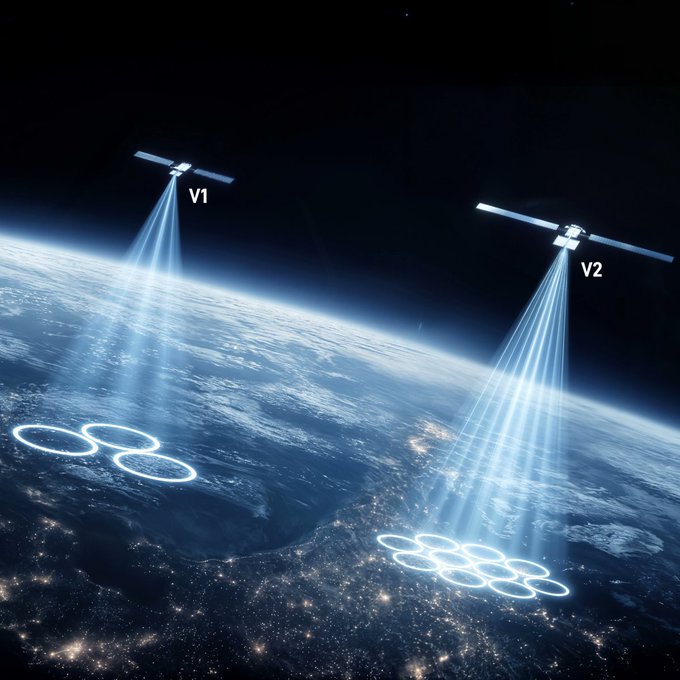
SpaceX will use new, larger satellites called "V2 Mobile," according to the company.
The satellite naming can get confusing because SpaceX now has several generations of satellites in development at once with similar names, and V2 Mobile is now added to the list:
- V1 Broadband - The first-generation Starlink satellites.
- V2 Mini - The current Falcon 9-launched Starlink broadband satellites.
- V3 - The new, much larger Starship-launched Starlink satellites, targeting about 1 Tbps of downlink capacity per satellite. The first batch of these was recently orbited (our story).
- V1 Mobile - The current Falcon 9-launched Starlink D2D satellites used for services such as T-Satellite. These are Starlink V2 Mini satellites equipped with an additional D2D payload.
- V2 Mobile - The upcoming Starship-launched, next-generation dedicated D2D satellites in this new 15,000-satellite constellation. Unlike the V1 Mobile, these are dedicated cellular satellites.
A Massive Upgrade In Capacity
Today’s DTC networks are primarily useful for messaging, voice, and relatively light data usage when terrestrial cellular coverage is unavailable.
SpaceX says each V2 Mobile satellite will provide roughly 20x the throughput of a first-generation DTC satellite, while the overall next-generation system should eventually offer more than 100x the capacity, with performance approaching terrestrial 4G/LTE and even 5G in many situations.
The increased capacity comes from the specialized V2 Mobile satellites, which use large phased-array antennas with thousands of steerable beams and operate in VLEO orbit.
But even more critical for capacity is the huge increase in wireless spectrum this constellation will have access to.
SpaceX Is Adding A Lot More Spectrum
Today’s T-Satellite DTC service uses a small slice of T-Mobile’s Band 25 spectrum, which limits performance.
More available spectrum means greater capacity, throughput, and potential performance.
This is why terrestrial cellular carriers like AT&T, T-Mobile, and Verizon have spent billions of dollars acquiring spectrum rights.
SpaceX has also greatly increased its spectrum holdings thanks to Dish/Echostar's demise as a fourth major terrestrial carrier. Echostar sold off its spectrum assets, and SpaceX acquired a large chunk, specifically intended to support this new D2D constellation.
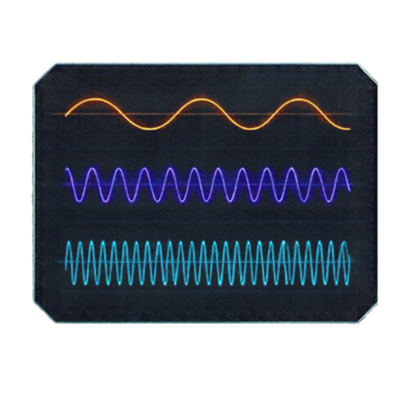
For comparison, T-Satellite currently uses 10 MHz of spectrum - 5 for uplink and 5 for downlink. By contrast, the FCC now authorizes SpaceX to use up to 25 MHz of uplink and 50 MHz of downlink spectrum in most of the US.
Going from 5 MHz downlink to 50 is a tenfold increase, but that is only part of the improvement.
The V2 Mobile satellites in the new constellation will also have more and much smaller beams, larger antennas, and other improvements (like the VLEO orbit) that will use that spectrum much more efficiently.
SpaceX itself will control much of this new spectrum rather than relying entirely on agreements with terrestrial cellular carrier partners.
But most of this spectrum is mid-band and not optimized for penetrating buildings, a limitation SpaceX is correcting...
SpaceX Buys 800 MHz Spectrum
In another major development just two days after the DTC constellation approval, SpaceX agreed to acquire a nationwide slice of up to 14 MHz of paired 800 MHz spectrum (7 MHz up & 7 MHz down). This was original Sprint Band 26/n26 spectrum that T-Mobile sold to Grain Management, a private investment company, which is now selling it to SpaceX.
SpaceX says this low-band spectrum will provide the wide-area and indoor coverage that its higher-capacity spectrum lacks, and it now explicitly plans to combine satellite coverage with a terrestrial network to make Starlink Mobile a “major mobile carrier” in the US.
The deal still requires FCC approval, and this week’s satellite D2D authorization did not include this 800 MHz purchase, but SpaceX says it ultimately intends to use the spectrum as part of a combined terrestrial-and-satellite network.
While this is a major development that will make Starlink Mobile more useful and viable when deployed, 14 MHz is a small amount of spectrum, especially compared to the amount of low-band spectrum the three major carriers hold.
Don’t Expect Anything To Change Overnight
This FCC approval and spectrum purchase are important milestones and big wins for SpaceX, but like Starlink's development and deployment, SpaceX will need a substantial portion of the constellation in orbit before its promised capacity increase becomes available to consumer nomads.
Building out the hybrid Starlink Mobile vision will also require a terrestrial network.
SpaceX says it intends to start deploying the new constellation next year, and since the V2 Mobile satellites are quite large, they can only be orbited using Starship - the Falcon 9 is not large enough. So orbiting the satellites depends on how well and how often Starship performs in the future.
The FCC has also given SpaceX deadlines for satellite deployments:
- 50% of the constellation (7,500 satellites) must be orbited by Oct. 7th, 2032
- 100% of the constellation must be in orbit by Oct. 7th, 2035
Assuming SpaceX starts launching the V2 Mobile satellites in 2027, that gives them ~5 years to get half the constellation in orbit and 8 years for the full constellation.
Additionally, commercial operation using the new EchoStar-derived spectrum cannot begin until the EchoStar transaction is finalized, expected in November 2027, although SpaceX can orbit satellites and use that spectrum for testing before then.
Will Current Phones Work?
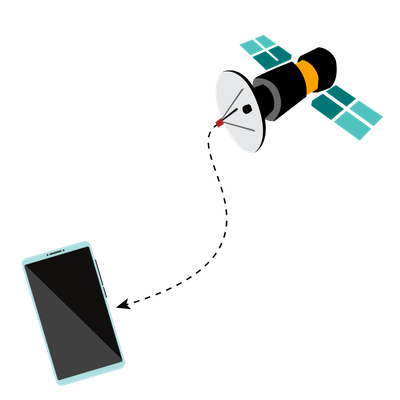 In many cases, yes - at least for some portions of the service.
Much of SpaceX’s new spectrum overlaps bands already used for terrestrial 5G, including the new 800 MHz Band 26/n26 spectrum, so many current phones should be able to use at least part of the next-generation service without hardware changes.
But to fully take advantage of newer 5G satellite-specific standards and additional spectrum, future phones will need added hardware and software support.
So this will be a gradual transition, and you should not worry about buying something today based on potential compatibility with this new system.
As detailed in our Late 2025 Industry Update, SpaceX has been putting significant pressure on hardware makers to support this spectrum. It will be interesting to see how many of them play along.
SpaceX Isn’t The Only D2D Player
SpaceX is far from alone in pursuing direct-to-device satellite connectivity, here is what other players are doing in the D2D space:
 AST SpaceMobile is building a competing broadband D2D constellation designed to connect directly to standard phones and has agreements with major carriers including AT&T, Verizon and others. It has already demonstrated voice, video, and 5G connections from space to unmodified smartphones, but hasn't entered commercial service.
Elveo Mobile, formed from the 2026 merger of Lynk Global and Omnispace, combines Lynk’s already-demonstrated D2D technology with Omnispace’s S-band spectrum. It also has backing from SES, one of the world’s largest traditional satellite operators. Elveo is targeting broader commercial service around 2028.
 Amazon Leo is developing a competitor to Starlink and is also competing in the D2D space. Amazon is acquiring Globalstar and will also power Apple’s satellite services, which today use Globalstar infrastructure for emergency messaging, Messages, Find My, and roadside assistance. Amazon has proposed a dedicated constellation of up to 5,105 D2D satellites, beginning deployment in 2028, using Globalstar’s L- and S-band spectrum to provide voice, messaging, and data directly to compatible devices.
AT&T, T-Mobile, and Verizon have also joined forces on D2D - formally launching a joint venture earlier this month to pool limited spectrum resources, promote common technical standards, and make it easier for multiple satellite providers to serve their customers. The effort is widely seen as a hedge against Starlink Mobile’s growing ambitions, giving the three major carriers a way to jointly support competing satellite networks while preserving their own existing D2D partnerships.
In short, the D2D market is rapidly developing, with several very different satellite architectures and carrier partnerships racing to eliminate cellular dead zones. While SpaceX does have some significant advantages, and now FCC approval for another massive constellation, it likely won't be the only D2D otion.
Concluding Thoughts
D2D/DTC technology has long been an exciting possibility for our audience of nomads, promising connectivity almost anywhere on a phone or other cellular device.
Today's options like T-Satellite service and Apple's system in partnership with Globalstar have already begun delivering on that promise, but only for limited low-bandwidth uses.
This next-generation system could substantially change how nomads get connected, similar to how Starlink opened up new options.
 If SpaceX eventually delivers LTE-like broadband speeds directly to phones and other cellular devices, satellite connectivity could become far more useful for staying connected while traveling through areas not covered by terrestrial cellular, whether on land, coastal waters, or the open ocean.
But this satellite-based connectivity will still have fundamental limitations, which is why SpaceX intends to build a hybrid space/terrestrial network.
Signals coming from space will always struggle more indoors, under heavy tree cover, in deep canyons, and in other challenging situations. This new satellite system will not replace terrestrial cellular networks, and it also won’t replace dish-based broadband systems like Starlink and Amazon Leo. It will most likely complement them by providing another layer of redundancy, at least initially.
It's clear SpaceX wants to compete more broadly and potentially become the fourth major carrier, filling the role Dish/Echostar failed to fill.
But even with the major jump in spectrum available to SpaceX, the major terrestrial carriers still control much more spectrum than SpaceX does.
However, even assuming the system comes with the promised technical capabilities, much will depend on how SpaceX monetizes the service for consumers - how much service will cost and what limitations will come with it?
It's way too early to speculate on that, but we hope that SpaceX learns from the whiplash changes it makes to Starlink that often leave customers frustrated and confused.

Learn More:
Starlink's Referral FAQ.
Use our referral link when purchasing equipment from Starlink.com and activating a consumer Residential or Roam data plan - and get a FREE month of service!
Someone on our team will also get a service credit, which helps us keep our multiple lines of service active for continued testing.
It's a win-win - you save money and help support MIRC!
Starlink Accessories from MobileMustHave
Check out these Starlink accessories sold by our friends at MobileMustHave:

Further Reading
- Mobile Satellite Internet Options -
 Our featured guide on all the current and future satellite internet options of interest to RVers and cruisers.
 - All our Satellite Internet Resources - Our collection of guides, gear center entries, and news coverage on satellite internet.
- Guide: Direct-to-Cell (DTC) Satellite Connectivity for RVers and Travelers - Our dedicated guide on D2D/DTC technology.
- Industry Update: Mobile Satellite Internet for RVers & Boaters - Our latest deep dive into the current state of the satellite internet world.
And here is all of our recent satellite internet coverage:




 Mobile Internet Resource Center was founded by Chris & Cherie of