
Key Points:
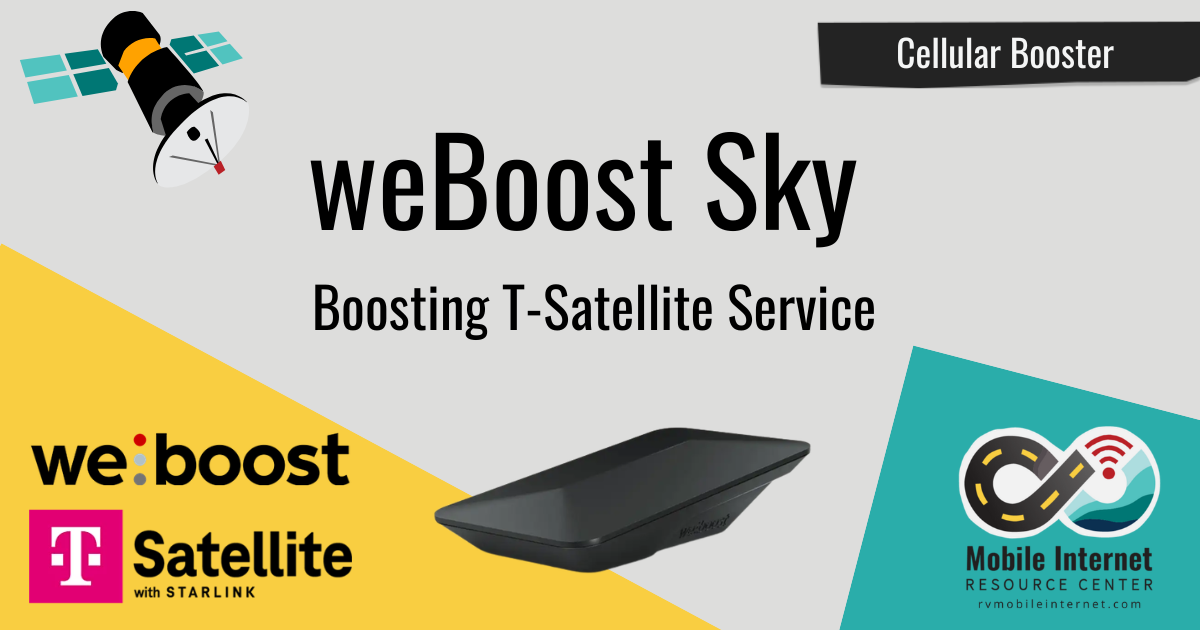
- weBoost has introduced the Sky, a $149.99 cellular signal booster designed specifically to improve T-Mobile's Starlink-powered T-Satellite service inside vehicles.
- The Sky has a compact, roof-mounted design with an integrated amplifier, up to 50 dB of gain, and a separate in-line interior antenna.
- While the Sky could improve messaging and supported T-Satellite apps in remote locations, T-Satellite remains a very limited connectivity option.
Cellular signal booster manufacturer weBoost has introduced the Sky, a new booster designed specifically for T-Mobile's Starlink-powered T-Satellite service.
Unlike conventional cellular boosters, which amplify signals from terrestrial cell towers across a few cellular frequency bands, the Sky focuses on the cellular spectrum T-Satellite uses from cellular transmitters attached to some Starlink satellites in low earth orbit.
Sky is designed to improve the reliability of satellite connections inside vehicles, where metal roofs and other obstructions like trees can make already weak satellite signals difficult for smartphones to receive.
At $149.99, the Sky is considerably less expensive than most traditional vehicle cellular boosters, but it is also much more limited.
Is Sky worth adding to a mobile internet arsenal? Read on for the details...
Table of Contents
Video Story
Coming Soon!
weBoost Sky Specifications
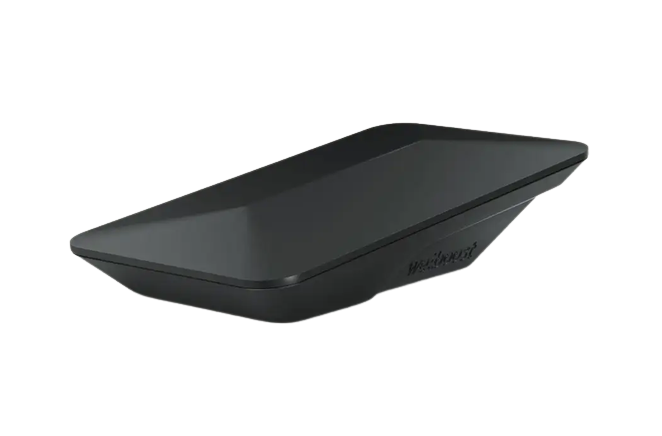
The weBoost Sky is a compact booster that combines an exterior antenna and amplifier into a single housing designed to mount on a vehicle's roof.
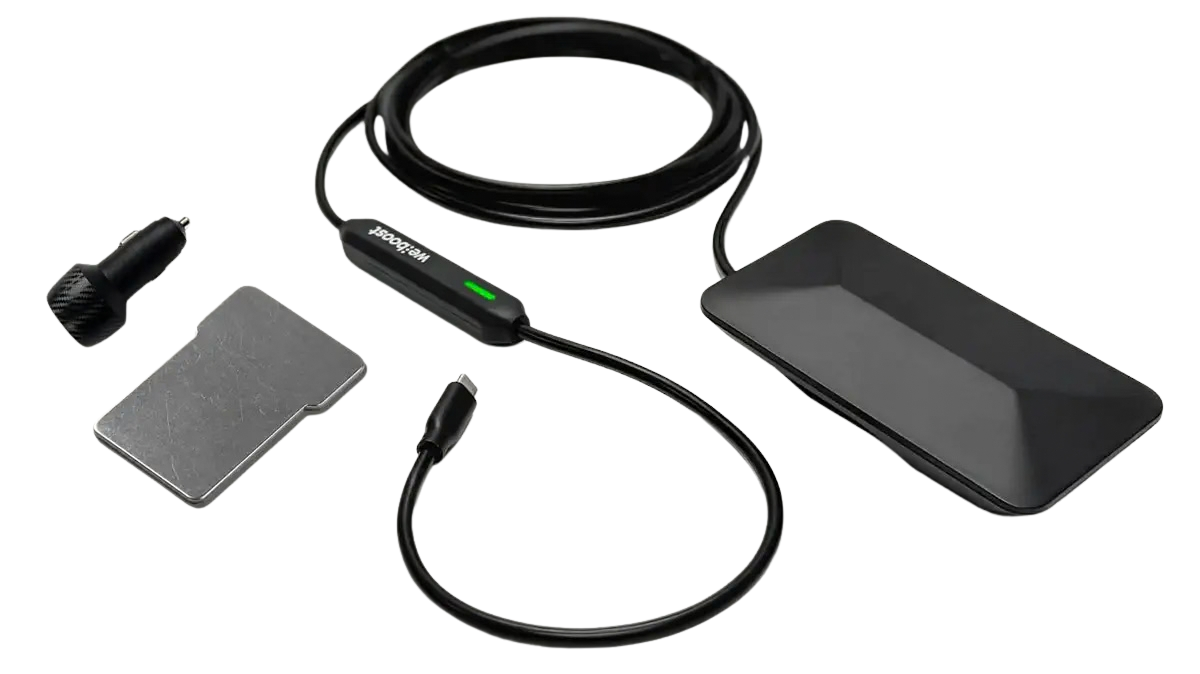
A cable runs inside the vehicle to a small, in-line interior antenna that provides the boosted signal to nearby compatible smartphones. The entire system is powered by USB-C, with no separate amplifier box or hardwired power connection, unlike most traditional booster designs.
The Sky amplifier is integrated directly with the exterior antenna, making the system simpler than most boosters. It also avoids the signal losses that can occur from cable runs between an outside antenna and an inside amplifier.
The Sky has the following specifications:
- Frequency Support: Band 25 (use for T-Satellite)
- Maximum Amplification: 50 dB advertised
- Outside Antenna: Integrated omnidirectional antenna, rated at 2.6 dBi
- Inside Antenna: In-line omnidirectional antenna, rated at 1.7 dBi
- Power: 5V USB-C, consuming less than 5 watts
- Dimensions: 4.8 x 2.8 x 1.4 inches
- Weight: 0.5 pounds
- Mounting: Magnetic roof mount, with an adhesive mounting plate included for nonmagnetic surfaces
- Price: $149.99
Amplification and Antenna Performance
T-Satellite uses LTE Band 25, specifically a small portion of Band 25 at 1910-1915 MHz uplink and 1990-1995 MHz downlink. However, the Sky boosts the entire band, not just the portion T-Satellite uses.
Communicating with satellites hundreds of miles overhead is challenging for a smartphone, particularly because the uplink signal it transmits is relatively low-powered.
weBoost advertises that the Sky can provide up to five times the uplink power of a smartphone alone, potentially improving reliability when sending messages and using supported satellite applications.
The exterior antenna is omnidirectional and rated at 2.6 dBi of gain. We don't have further details on the antennas, but weBoost markets the Sky as optimized for satellite communication, and the overall design suggests it's optimized for overhead coverage. This is unlike most booster antennas, which are optimized to collect and boost signals from terrestrial cell towers near the horizon.
Use Cases
T-Mobile's T-Satellite service allows compatible smartphones to connect directly to specially equipped Starlink satellites when conventional terrestrial cellular service isn't available.
The service initially launched with basic text messaging but has since expanded to include limited data connectivity for supported applications, including messaging, navigation, weather, and some communication apps.

The weBoost Sky is somewhat unusual because it supports a service that differs significantly from conventional cellular connectivity and boosters designed to support terrestrial cellular. For our audience of nomads living, working, and traveling in vans, boats, and RVs, this could help those who regularly take their vehicles in remote areas and only need basic connectivity.
This can be useful in a tow vehicle, TOAD, or RV/boat while exploring areas outside cellular coverage.
weBoost also specifically markets it as effective for getting a T-Satellite connection in forested areas.
Important Limitations
 Sky is a one-trick pony booster designed specifically for Starlink's low-bandwidth direct-to-cell service intended to fill gaps in terrestrial cellular coverage. Although the service now supports more than basic text messaging, it is still a supplemental connectivity service rather than a broadband internet connection.
T-Satellite is not traditional mobile internet, and it isn't Starlink broadband service.
Other limitations to be aware of:
- A booster like the Sky can strengthen an available T-Satellite signal, but it can't increase satellite capacity or enable applications T-Mobile doesn't support.
- Sky is also not a general-purpose booster like weBoost's other mobile products.
- T-Satellite currently only works with smartphones. Sky is therefore not useful with a cellular router or cellular mobile hotspots.
- Despite T-Satellite broadcasting on Starlink's satellite network, Sky does not amplify conventional Starlink internet service, Wi-Fi, or signals from a Starlink dish. It works only with the T-Satellite service broadcast over LTE Band 25.
- Since T-Satellite is designed to connect automatically when terrestrial service is unavailable, the Sky cannot be used to force an arbitrary smartphone onto the satellite network.
- Limited international use - Sky can be used in Canada, but like all US boosters, it may be illegal in most other countries.
- T-Satellite is only available to T-Mobile customers subscribed to the service - it's available with their flagship smartphone plans or as an add-on service. Customers of other carriers can also subscribe using eSIM.
- The Sky will not work with other direct-to-cellular services, such as Apple's Satellite service, as they are broadcast differently than T-Satellite. Additionally, Sky will not be very useful for Starlink's planned cellular network as it doesn't support the main frequencies Starlink will use.
Can Traditional Boosters Work For T-Satellite?
Some traditional cellular boosters also amplify Band 25, so why get a niche device like the Sky instead of a booster that can also work with terrestrial cellular?
The issue is that traditional booster kits, including those from weBoost, use exterior antennas primarily designed to communicate with terrestrial cell towers near the horizon.
These antennas concentrate their reception toward lower elevation angles, making them less effective at receiving signals from satellites passing overhead.
These antennas were never designed or intended to capture signals from above the antenna.
As a result, conventional boosters may provide some benefit for T-Satellite, but they will likely be less effective with T-Satellite service, especially compared to the Sky.
Concluding Thoughts
 The weBoost Sky is an interesting new product in the cellular booster space - a market that hasn't seen much innovation in many years. Rather than being a general-purpose device, the Sky targets the very specific niche of T-Satellite.
But at least on paper, the Sky looks like it will serve that niche well, with a compact, integrated design, simple USB-C power, and a $149.99 price. For those who need more reliable T-Satellite service in a vehicle, the Sky is a relatively inexpensive option.
However, its usefulness depends heavily on how someone intends to use T-Satellite.
For our audience of RVers, boaters, and nomads who rely on mobile internet connectivity for everyday online activities, the Sky doesn't provide a new internet option. The T-Satellite service, at least for now, remains fundamentally limited in what it can do.
But for those who venture into remote areas and want a backup way to send messages, share locations, or access basic satellite-supported apps, the Sky could be worth considering.
Further Reading
- Mobile Satellite Internet Options -
 Our featured guide on all the current and future satellite internet options of interest to RVers and cruisers.
 - All our our Satellite Internet Resources - Our collection of guides, gear center entries and news coverage on satellite internet.
- Latest Satellite Industry Update - Our deep dive into the state of the satellite internet world.
- Gear Center: T-Mobile Postpaid Consumer Plans
And here is all of our recent satellite internet coverage:




 Mobile Internet Resource Center was founded by Chris & Cherie of