

 Amazon Leo is Amazon’s upcoming satellite internet service, previously known as Project Kuiper. Like Starlink, Leo is designed to deliver internet service via a network of satellites in low Earth orbit, meaning the satellites fly much closer to Earth than older satellite internet systems. That shorter distance can reduce lag and make satellite service more practical for everyday uses like video calls, streaming, remote work, and general web browsing.
Amazon began launching its first full-production Leo satellites in April 2025 and has been steadily building out the constellation since then. As of late May 2026, Amazon says it has deployed 331 Leo satellites so far for an initial network of more than 3,000 satellites.
Amazon has already started limited enterprise preview testing, but it is not yet available to the general public. Once it's commercially available, it is likely to be geographically limited and capacity-constrained, with coverage expanding over time as more satellites are orbited. Amazon also announced plans to acquire Globalstar, which is intended to support future direct-to-device satellite services for phones and other connected devices, but that is separate from the initial dish-based Leo broadband service.
Customers will use a flat-panel antenna to connect to the Leo network, similar to those used by competitor Starlink.
Amazon Leo Terminals
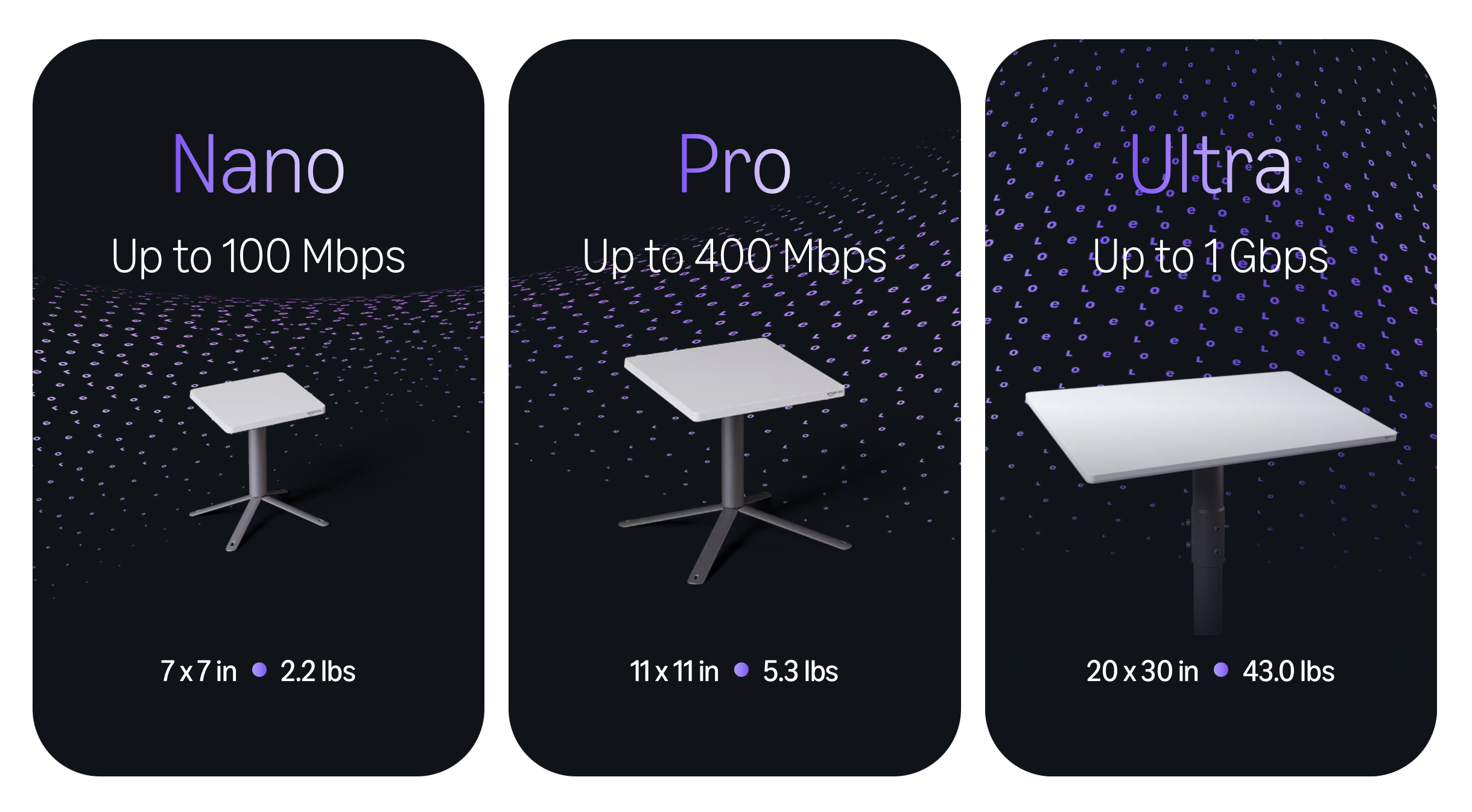 Amazon will initially offer three terminal options:
- Leo Nano - An ultra-compact and "lower cost" design measuring 7" square and weighing just 2.2 pounds. This tiny design supports 100 Mbps speeds.
- Leo Pro - The standard terminal is 11" square, 1" thick, weighs 5.3 pounds, and supports 400 Mbps.
- Leo Ultra - This is a professional/enterprise receiver measuring 20" x 30" and weighing a hefty 43 pounds. It is capable of up to 1 Gbps download and 400 Mbps upload.
Amazon claims that Leo Ultra (but not the Nano or Pro) is capable of full-duplex performance - delivering peak upload and download speeds simultaneously.
Amazon has not revealed any pricing for the terminals, nor has it provided details on data plans.
News, Videos, & Status
Testing Status
Once Amazon Leo is available for purchase, we have plans to obtain and test their product.
Additional Reading
Related Articles
Related Guides
Alternatives to Consider
For other featured mobile satellite options:



This Review Contains Additional Member Exclusive Content!
We are Honored to be Member Funded! No 3rd party ads and no selling (but may contain affiliate links)
Our members fund our in-depth independent reviews.
This entry may contain additional member exclusive content such as testing notes, field testing data, user interface tours, comparisons to alternatives, analysis, tips, videos and discounts.
Members also get interactive guidance, alerts, classroom and more.

Are you a member? Please log in above to access your member exclusive content!
Other Ways to Support Our Work At MIRC
Member Exclusive Content Below
- Thoughts & Analysis - Favorite Features & Potential Downsides
- Deep Dive
- Amazon Leo Delays
Purchasing Options
Purchasing Links & Disclaimer
We don't sell stuff, we are primarily member funded. Some links below may be affiliate links (see our disclaimer), which also helps fund MIRC.
The vendors displayed below provide larger discounts to our MIAs that we have negotiated instead of displaying affiliate links while they are logged in.
MIA Discounts - Learn & Save!
Our Mobile Internet Aficionados (MIA) get special discounts from the below vendors. Members please check for discount codes before ordering. With savings up to 11% off, you could save more than your membership cost!









Not yet available for purchase. See Amazon Leo website for more information.
The guides below have been hand-picked to help further your education about mobile satellite:








 Mobile Internet Resource Center was founded by Chris & Cherie of