
Key Points:
- Netgear and AT&T have launched the Nighthawk M8 Pro, a new flagship 5G mobile hotspot featuring Qualcomm's next-generation X85 cellular modem.
- The M8 Pro retains many of the M7 Pro's features, including Wi-Fi 7, a 2.5 Gbps Ethernet port, and external antenna ports, while adding longer battery life.
- The M8 Pro is available now from AT&T for $479.99.
Netgear and AT&T have launched a new flagship 5G mobile hotspot, the Netgear Nighthawk M8 Pro (MR8400), featuring Qualcomm's X85 cellular modem.
The M8 Pro succeeds the Nighthawk M7 Pro, which launched in September 2024 as the first mobile hotspot powered by Qualcomm's X75 modem.
The M8 Pro continues Netgear's traditional premium hotspot design, with a square form factor, touchscreen, removable battery, Ethernet port, and two TS-9 external antenna ports.
The most significant change is the move to the Qualcomm X85, which brings newer 5G Advanced capabilities. Netgear is also emphasizing business and FirstNet users, with optional remote management through Netgear's cloud service, called Netgear Insight.
Overall, the M8 Pro shares much of its hardware and feature set with the M7 Pro, making this more of a generational update than a major redesign.
So, what has changed?
Table of Contents
Video Story
Coming Soon
Nighthawk M8 Pro: A New Flagship With Qualcomm X85
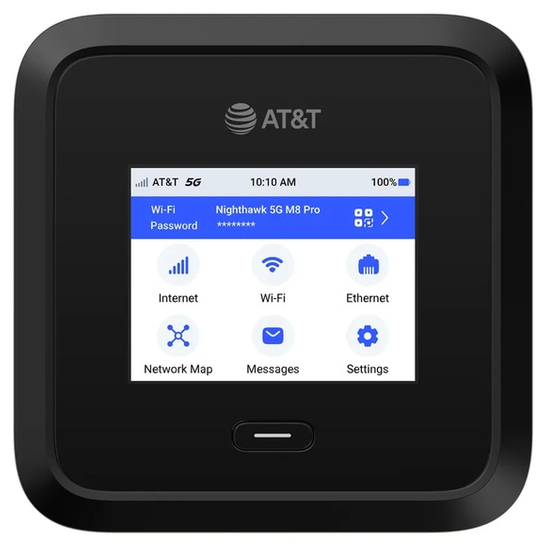
At first glance, the M8 Pro looks just like the M7 Pro - it has the same design and form factor.
It measures 4.14 x 4.14 x 0.92 inches and weighs approximately 10.6 ounces with the battery installed, making it slightly thicker and heavier than the previous model.
But at the heart of the M8 Pro is Qualcomm's X85 modem, the successor to the X75 found in the M7 Pro. This is the same modem that powers recently released flagship smartphones, such as the Samsung S26 series, and it's a cousin of the X80 used in the iPhone 17, 17 Pro, and US version of the 18 Pro Max.
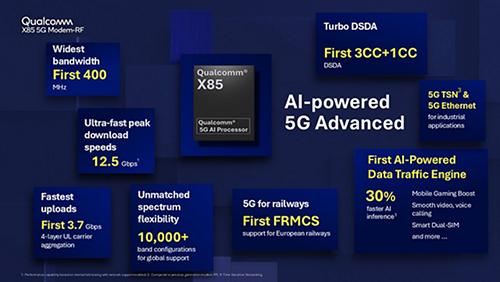
The X85 is a newer-generation 5G Advanced modem that supports more sophisticated carrier aggregation, improved uplink capabilities, support for satellite networks, and additional AI-assisted features designed to improve network efficiency and performance.
On paper, the X85 supports up to six aggregated Sub-6 GHz 5G carriers and 400 MHz of combined bandwidth, compared with five carriers on the X75. However, the M8 Pro's published specifications include support for up to 5x aggregation on FDD bands (125 MHz) or 4x aggregation on TDD bands (350 MHz).
Qualcomm also advertises theoretical download speeds of up to 12.5 Gbps for the X85 modem platform, compared with 10 Gbps for the X75.
However, those are the modem platform's theoretical maximums, and individual platforms are lower due to other factors.
For the M8 Pro, the maximum theoretical 5G download speed is 7.5 Gbps, the same as the M7 Pro.
In practice, real-world speeds will depend on the available cellular spectrum, tower capabilities, network congestion, signal conditions, and other factors. You shouldn't expect either the X85's peak modem speeds or the M8 Pro's theoretical maximums in typical use.
The newer modem should, however, offer more opportunities to improve performance as AT&T continues upgrading its network, but the size of any real-world advantage over the M7 Pro remains to be tested.
Cellular Bands and 5G Support
Like the M7 Pro when it first launched, the new M8 Pro is available first on AT&T.
What's different this time around is that the band support isn't exclusive to AT&T, and the device supports bands for the other two carriers.
This is a change in mobile hotspot design we've wanted for years.
Typically, mobile hotspots sold by carriers will be variants with cellular bands for other carriers purposely disabled to specifically make it more difficult or impossible to use the device on another carrier.
Fortunately, the M8 Pro, although exclusive to AT&T (for now), isn't hobbled and supports all major Sub-6 GHz and LTE bands used by Verizon and T-Mobile.
Here are the bands supported by the new M8 Pro:
- Sub-6GHz 5G: n1, n2, n3, n5, n7, n12, n13, n14, n25, n26, n30, n38, n40, n41, n48, n66, n70, n71, n77, n78
- mmWave 5G: None
- 4G/LTE: 1, 2, 3, 4, 5, 7, 12, 13, 14, 25, 26, 29, 30, 38, 40, 41, 42, 43, 48, 66, 71
 This covers all major bands used in North America except LTE Band 28, which one carrier in Mexico uses. One asterisk in the spec sheet notes that 5G band n29 will be added in a future firmware update, although n29 isn't an important band at present.
The M8 Pro supports both the C-Band and 3.45 GHz portions of AT&T's n77 5G+ network, which are important for the carrier's higher-speed 5G coverage.
International support outside North America is more limited. While it supports many commonly used LTE and 5G bands, including the widely deployed 5G n78 band, it lacks several important low-frequency bands used outside North America, particularly LTE Bands 8, 20, and 28 and 5G n28.
One interesting detail in Netgear's technical specifications is support for higher-power transmissions on several mid-band frequencies, including Power Class 2 and Power Class 1.5 configurations on n77.
These capabilities could potentially improve uplink performance and connectivity in certain conditions
However, the actual benefits will depend on AT&T's network support.
Like the M7 Pro, the M8 Pro does not support millimeter-wave (mmWave) 5G. This means it cannot access AT&T's limited high-band 5G+ coverage, which is primarily found in select venues and dense urban locations. This is not a major downside for our audience of mobile users, and adding mmWave would likely increase the cost of the hotspot. If Netgear follows past variant deployment patterns, it may release a version that supports mmWave in the future.
eSIM Support?
 One interesting snag is eSIM support. Netgear's user manual explicitly describes the ability to download and store multiple eSIM profiles, including third-party travel eSIMs, through the Netgear app, and switch between them and a physical nano-SIM.
However, AT&T's published specifications list only a physical nano-SIM, and a Netgear PR representative told us the AT&T version doesn't support eSIM.
That suggests the eSIM capability is reserved for future variants.
We are seeking further clarification from Netgear and will update this article if we learn more.
Wi-Fi 7 and Local Connectivity
The M8 Pro continues to offer tri-band Wi-Fi 7, supporting 2.4 GHz, 5 GHz, and 6 GHz.
 However, despite supporting three frequency bands, the M8 Pro does not operate on all three simultaneously. Like its predecessor, the M8 Pro requires Plugged-In Mode, with the battery removed and the device powered from an AC adapter, to enable 6 GHz Wi-Fi. FCC regulations also restrict this mode to indoor use, although that is clearly defined when it comes to use in an RV or boat.
The hotspot can operate on two Wi-Fi bands simultaneously and supports Wi-Fi 7 Multi-Link Operation (MLO), allowing compatible devices to use multiple Wi-Fi connections.
The hotspot supports up to 64 connected devices, making it useful for sharing a cellular connection with multiple computers, tablets, streaming devices, and other equipment.
Ethernet, USB, and External Antennas
The M8 Pro retains the wired connectivity options that made the M7 Pro particularly useful for mobile internet setups.

These include:
- 2.5 Gbps Ethernet port: Can connect directly to wired equipment or provide an internet connection to a downstream router.
- USB-C: Supports charging and USB tethering to compatible devices.
- Two TS-9 antenna ports: Let you connect external cellular antennas to improve reception in challenging signal conditions.
These features are particularly useful for RVers and boaters who want to integrate a cellular hotspot into a larger mobile internet setup.
The hotspot also supports IP passthrough, allowing a connected router to receive the cellular connection's assigned IP address and avoid an additional layer of NAT.
Wi-Fi and Ethernet offloading, like the M7 Pro, are also supported, allowing the hotspot to use an available Wi-Fi or wired internet connection instead of cellular data. You can configure Ethernet offloading with cellular backup.
Battery and Plugged-In Mode
The M8 Pro has a removable 5,185 mAh battery, rated for up to 12 hours of operation.
This improves on the M7 Pro's original advertised battery life of up to 10 hours, although real-world battery life depends heavily on several factors, including usage.
As with previous Netgear flagship hotspots, the M8 Pro can also operate directly from external power with the battery removed in what Netgear calls Plugged-In Mode.
Removing the battery and powering it directly lets the hotspot operate with fewer performance restrictions, including improved Wi-Fi coverage and access to the 6 GHz band.
While not yet confirmed, the M8 Pro will likely also be compatible with Netgear's "Home Cradle." The Home Cradle has two Gigabit Ethernet ports for more wired connection options and an integrated cooling fan and is designed to support Plugged-In Mode.
Firmware and Cloud Management Features

The M8 Pro includes a color touchscreen to view connection information, monitor data usage, and change basic settings, similar to the M7 Pro.
It also supports management through Netgear's mobile app and the traditional on-device user interface.
With this launch on AT&T Business, Netgear is emphasizing its Insight Pro cloud-management platform, which allows organizations to remotely manage multiple deployed hotspots, including monitoring connectivity and configuring devices.
Insight management requires a separate subscription and isn't necessary for most of our mobile-user audience.
Pricing and Availability
The Netgear Nighthawk M8 Pro is available now to AT&T business customers for $479.99, with installment options available as well.
The announcement said consumer availability is expected to begin at AT&T retail stores in February 2027 at about the same $479.99 price, but when we checked AT&T's consumer website, it's already available there for the same price.
For comparison, AT&T currently lists the M7 Pro at $449.99, making the new flagship $30 more expensive at full retail pricing.
This is a small difference, and it's worth spending the $30 to get a generational upgrade in the cellular modem.
We expect Netgear to release other variants in the future, similar to the M6 and M7 series of hotspots.
Plan and Carrier Considerations
As always, the cellular data plan matters as much as the hardware.
 According to the press release, the M8 Pro is currently an AT&T Business exclusive device that must be purchased with a compatible AT&T data plan. At press time, the only options for AT&T Business plans in the system with a hotspot purchase are AT&T's Wireless Broadband plans.
These plans are one of our Top Picks and provide unlimited, speed-capped data at three tiers:
- Premium (100 Mbps) - $100/month standalone or $80/month if bundled with a phone plan
- Advanced (50 Mbps) - $80/month or $60/month if bundled with a phone plan
- Standard (25 Mbps) - $70/month or $50/month if bundled with a phone plan
Unfortunately, with these plans, the speed restrictions can negate much of the performance advantage of a high-end modem like the X85.
These plans also have usage restrictions, including prohibitions on certain types of streaming and other activities, but we have not seen those terms enforced.
At press time, AT&T offers the following postpaid DataConnect plans when purchasing an M8 Pro (prices are with autopay):
- 50GB for $55/month
- 100GB for $90/month
AT&T Prepaid data plans are only available in stores, and the press release states that the M8 Pro will be in stores in February 2027.
The limited data plan options remain a fundamental frustration for premium mobile hotspots. Hardware capabilities keep improving, but suitable data plans that can really take advantage of them have not always kept pace.
Those using grandfathered AT&T plans should also be particularly cautious about upgrading, particularly LTE-only plans like Unlimited Plus or the Mobley Connected Car plan. Upgrading a device through AT&T could also cause you to lose a valuable grandfathered plan, and since these plans don't support 5G, the X85's capabilities are irrelevant.
Finally, despite the M8 Pro's extensive band support, it is still being sold as an AT&T-specific device. To use it with plans on other carriers, it would need to be unlocked.
Member Exclusives Below:
Bonus Member Only Content Available!
We go extra for our premium members - who make this resource center possible (did you notice the lack of 3rd Party advertising?). We have included some additional information in this news article just for our members - analysis, guidance and/or insider tips.
If you're not yet a member, please consider joining us. Extra content like this is one of the many perks we offer - in-depth content, guidance, discounts, alerts, classroom and more.

If you are already a member, please log in above to see the special content we have prepared for you.
Concluding Thoughts
 The Nighthawk M8 Pro continues Netgear's tradition of bringing premium cellular technology to its flagship hotspots. The M7 was the first mobile hotspot to use the X75, and the M8 Pro is the first with the X85.
The Qualcomm X85 is a big advancement, bringing newer 5G Advanced capabilities and potentially better performance as AT&T's network evolves.
However, the M8 Pro is not a major redesign. It retains much of the M7 Pro's features and capabilities. The biggest change, besides the upgraded modem, is support for all three major carriers, even though this is an AT&T device. This means the M8 Pro could be a great multi-carrier option once unlocked.
For RVers, boaters, and other mobile users, the M8 Pro looks like a capable and very future-proof premium hotspot.
But for those who already have an M7 Pro, the newer modem alone probably doesn't justify an upgrade. How much improvement the X85 delivers will depend on real-world performance, particularly in weaker signal conditions, and on whether the local network supports the X85’s advanced features.
Further Reading
- Guide: Understanding & Selecting Mobile Hotspot Devices (MiFi, Jetpacks, AirCards) - Our featured guide to mobile hotspots of interest to RVers and cruisers.
- Industry Update: Our latest Mobile Hotspot Industry Update
- Overview: Netgear Nighthawk M8 Series Hotspots
- Overview: Netgear Nighthawk M7 Series Hotspots
- All Our Cellular Resources
Related News:







 Mobile Internet Resource Center was founded by Chris & Cherie of
