


Keeping Connected On The Go - Without Starlink
SpaceX's Starlink satellite broadband constellation has become a game-changing option for mobile internet for many RVers and boaters, allowing nomads to stay connected in places where reliable broadband was previously difficult or impossible. But what alternatives are there to Starlink?
Starlink has drawbacks, and we at the Mobile Internet Resource Center are often asked for advice on alternatives.
One may not want to use Starlink for many reasons, such as obstructions, changing plan pricing or terms, off-grid power consumption concerns, or concerns about Starlink’s corporate leadership or direction.
Can nomads still travel with reliable connectivity without relying on Starlink?
The answer for most is YES!
With a little work and travel planning, you can completely dial back or eliminate your dependency on Starlink.
Even if you plan to keep Starlink in your connectivity arsenal, knowing your alternatives can pay off when you run into congestion or obstruction issues.
Read on for details in our guide:
If you're a member, please log in above to see your exclusive content.
Don't need a membership? Other ways you can support our work here:
-
As seen in our videos!
-
Get a FREE Month of Starlink!
And our team will get one too!
-
Get a FREE Month of T-Mobile Unlimited Data
Join the Calyx Institute, and get a bonus month - and we do too!
-
Save $20 on Visible
Verizon's prepaid phone plan, we also get a $20 credit.
-
Share About Us!
Link to our content, tell others about MIRC. It's Free!
It is with huge gratitude to our members for making the free unbiased educational content on our site possible.
Our members get exclusive access to our in-depth content, classrooms, vendor discounts (that can save you more than membership!), alerts, insider info and interactive guidance. They can even book private advising sessions.
If mobile internet is an important part of your lifestyle, consider helping make MIRC possible by joining or supporting our mission.
Starlink Alternatives Video
Join MIRC co-founder Chris as he goes over some of the alternative strategies to using Starlink as your primary mobile internet solution:
Why You Might Want an Alternative to Starlink
Ask in almost any RV or boating group how to get internet while traveling, and dozens of people will give you the simple answer: Starlink!
But for many, Starlink isn't the ideal solution.
Here are a few reasons why some nomads might not rely primarily on Starlink or forego it altogether:
- Additional Cost - If cellular already meets your needs, adding Starlink means another piece of hardware and another service bill. However, Starlink isn't always more expensive than a high-cap cellular setup, especially when you need multiple cellular plans.
- Dropouts - For uninterrupted Starlink service, you need a relatively clear view of the sky. Parking under trees or in the shade can cause dropouts, sometimes severe enough to prevent you from getting things done, especially with more sensitive connections like video conferencing and broadcasting.
- Service Issues - A strong 5G connection can outperform Starlink, particularly for uploads. Starlink service is also subject to congestion slowdowns in crowded markets, just like cellular, which can significantly reduce performance.
- Changing Plans & Policies - Starlink frequently changes plan pricing, names, features, and usage restrictions, requiring customers to keep up with the latest terms. Starlink doesn't grandfather plans or terms, so changes can drastically affect even existing customers.
- Large Equipment - The Starlink Mini dish reduces the size and power footprint compared to the standard system, but it still takes up more space than a cellular-only setup.
- Higher Power Usage - Connecting via Starlink uses more power than a cellular-based solution, which matters for those using off-grid power solutions like solar.
- Concerns About Supporting SpaceX - Some consumers prefer not to financially support SpaceX because of concerns about the company’s leadership, policies, business practices, or direction.
Whatever your reason, fortunately, good alternatives can replace or complement Starlink in your mobile connectivity arsenal.
For more information on the Pros & Cons of Starlink:
Cellular: The Primary Starlink Alternative
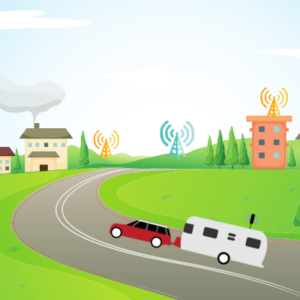
Cellular data has been the primary way many RV and boat nomads have stayed online for years, and coverage, capacity, and especially performance have improved substantially in the 5G era.
If you have a modern 5G device with good mid-band cellular support and a strong signal, cellular can substantially outperform Starlink. This is especially noticeable for uploads, where strong mid-band 5G can provide much faster performance.
Of course, the catch with cellular is coverage - every carrier has dead zones, and no carrier is "the best" nationwide.
However, cellular coverage and especially performance have improved substantially in recent years. If you build a connectivity solution that can tap into two or even three different carriers, you might be surprised at just how many places you can stay connected.
Multi-carrier plans now keep you connected via multiple carriers with a single data plan. More advanced mobile routers can also manage several internet connections for automatic failover and load balancing. Some platforms support bonding, which combines multiple connections into a single, redundant connection.
For travelers who usually stay within cellular coverage, a multi-carrier cellular setup can provide excellent performance and redundancy and may eliminate the need for Starlink. The trade-off is that it takes more planning, and multiple high-cap cellular plans can cost as much as or more than Starlink.
We have extensive resources here at the Mobile Internet Resource Center to help guide you on the options:
For more on cellular data and using multiple internet sources simultaneously:
Multi Carrier Data Plans
Some data plans now work with multiple carriers, giving you the benefit of multiple coverage maps without using multiple SIM cards or paying for multiple data plans.
Some options work only on specific devices, while others support a broader range of compatible hotspots, routers, or phones.
One example is RoamLink by our partners at MobileMustHave.com. RoamLink supports compatible Peplink routers and, on eligible plans, Bring Your Own Device activations on compatible hotspots, cellular routers, and supported phones.
For more on Multi-Carrier Plans:
Cellular Signal Enhancing Tips
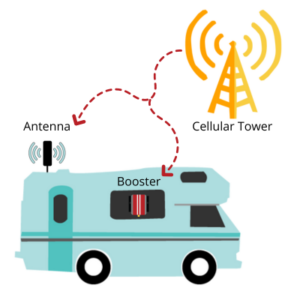
When using cellular connections, you can use signal-enhancing tactics to pull in weaker signals and minimize drops and dead zones.
The most common option is a roof-mounted omnidirectional antenna connected to an internal cellular router or hotspot. Good placement matters - ideally, the antenna should be above or away from nearby metal, other antennas, and major obstructions that can degrade its signal pattern.
Omnidirectional panel antennas also perform exceptionally well when installed inside an RV or boat, as long as the walls are fiberglass without metal skin or insulation.
An omnidirectional antenna can receive signals from towers in any direction. At a fixed location, a directional antenna can sometimes help when you know the tower direction, but this requires setup and aiming.
Directly connected external antennas require antenna ports, which generally limits this approach to cellular routers and some hotspots.
Cellular boosters can also help in some niche weak-signal situations, but they have trade-offs and are not usually the best choice for modern 4x4 MIMO cellular connections.
For more information on signal enhancement, see our guide:
Planning Your Travels Around Coverage Maps
If you rely on cellular, keep in mind that signal isn't everywhere, so you'll depend on the coverage maps for the carriers you have onboard.
The good news is that cellular coverage has continued to expand, while 5G has brought major improvements in capacity and performance across many existing coverage areas. Rural, wilderness, and offshore dead zones still remain, however.
There are multiple resources for planning your travels around connectivity, from apps like our own 'Coverage?' (putting the coverage maps on your phone) to crowdsourced signal-finding apps, to using reviews of campgrounds & marinas. We cover these options in our Travel Planning guide:
For resources on Travel Planning:
Wi-Fi as Another Internet Source
Public Wi-Fi at campgrounds, marinas, libraries, hotels, coffee shops, and other locations can also reduce your dependence on Starlink and cellular data. It is rarely reliable enough to be a primary connection for demanding users, but a good Wi-Fi network can be a useful backup or supplemental option.
A router that supports Wi-Fi-as-WAN can connect your entire local network to an external Wi-Fi source, while a dedicated Wi-Fi CPE or other range-extending gear can sometimes help reach a distant access point. But better receiving gear cannot fix a congested or poorly connected public Wi-Fi network and, unfortunately, there are many poorly-performing public Wi-Fi networks out there.
For more on using Wi-Fi as an internet source:
Redundancy over Starlink Alone
Even if you keep Starlink as part of your connectivity arsenal, having multiple options to get online has been and continues to be the most reliable way to stay connected in a mobile lifestyle.
When you embrace redundancy, you have more options to try or tweak when one option isn't performing as you need.
This can include having multiple cellular options on board, using public Wi-Fi sources, and even using satellite internet as part of your arsenal.
For more information on Redundancy:
Keeping Starlink as a Backup
If your goal is to reduce your dependence on Starlink rather than avoid SpaceX entirely, you can still keep Starlink hardware available as a backup for places where cellular and Wi-Fi do not work.
Treating Starlink as a "reserve parachute" can provide broadband coverage in remote locations without making it your primary internet connection.
For RVers and other land-based travelers, Starlink's current Roam lineup includes tiered data and Unlimited options. The capped data plans continue with unlimited low-speed data after you use your high-speed allotment, rather than charging for per-GB overages. You can also switch to a higher-tier Roam plan when you need more high-speed data.
Boaters can use Roam as backup connectivity on inland waterways and in territorial waters up to 12 nautical miles from shore, but use in territorial waters is generally limited to 5 consecutive days and 60 total days per year.
Standby Mode is another inexpensive backup option. It currently costs $10/month and provides unlimited data at speeds up to roughly 500 Kbps, enough for basic messaging and light connectivity.
Starlink says Standby Mode is not intended for maritime or in-motion use. However, reports indicate that it continues to work at speeds below roughly 10 mph, which can make it useful for many boaters, particularly while anchored, in marinas, or cruising slowly on inland and coastal waters.
We have a video with some Standby Mode testing information here:
Starlink changes its plans and policies frequently, so check our current Starlink News articles before deciding which backup strategy makes sense.
For more information on Starlink:
Other Satellite Options
Starlink isn't the only way to stay connected when cellular and Wi-Fi are unavailable. None of the alternatives below is a comparable mobile broadband option to Starlink, but several can cover basic communications or specialized needs without requiring Starlink service.
Satellite Communicators
If you don't need broadband bandwidth when you're off the coverage map, handheld satellite communicators can provide two-way messaging, location sharing, SOS services, tracking, and weather reports. Some newer devices, including Garmin inReach models, can also exchange photo and voice messages.
These devices remain useful because they are purpose-built for remote communications, generally have long battery life, and can provide coverage well beyond cellular networks without requiring a full satellite broadband system.
Smartphone Satellite Messaging
Many modern smartphones now include satellite connectivity that may be enough for basic safety and coordination needs without separate satellite hardware. Apple's satellite features on supported iPhones use Globalstar and can provide messaging, Emergency SOS, location sharing, and other limited services.
Verizon also offers satellite SOS and basic two-way text messaging through Skylo, but only on certain phones.
T-Mobile's T-Satellite service supports messaging and a growing selection of satellite-optimized apps on compatible phones, including for customers who use another cellular carrier. However, T-Satellite runs on Starlink's direct-to-cell network, so it is an alternative to owning Starlink hardware, not an option for someone who wants to avoid SpaceX entirely.
Low-Bandwidth Satellite Data
For those who need connectivity beyond cellular coverage, traditional satellite services remain an alternative to Starlink, though they are more expensive and offer worse performance. These include GEO-based systems and Iridium's global LEO network, with options ranging from basic voice and messaging to limited internet access.
Compared with Starlink, these systems are slower and more expensive for the data they provide, and many require specialized hardware and service plans. However, they can offer dependable coverage in remote areas and are often designed specifically for maritime and remote land communications, weather, and safety use.
These services are better suited as specialized or backup communications since they aren't considered broadband like Starlink.
Starlink Competitors
Starlink remains far ahead of other consumer-accessible mobile broadband satellite options, and no directly comparable non-SpaceX service yet exists that typical RVers and recreational boaters can purchase and use in the same way.
Amazon is actively deploying Amazon Leo (formerly Project Kuiper), a competing LEO broadband constellation. Amazon says it plans portable service options and is also developing maritime service. Amazon Leo is one of the most important potential future alternatives to Starlink, but it is not yet available.
Other companies are also looking to compete with Starlink, but most are still an even longer way from providing real service. Others, like Eutelsat OneWeb, already operate a LEO broadband constellation, but they focus service on government and enterprise customers, not consumers.
For all the latest on Satellite news and options
Summary: You Can Keep Connected without Starlink
You have other options if you don't want to rely on Starlink for connectivity.
After all, nomads stayed connected via other means long before Starlink existed.
Building a cellular-centric solution may take extra knowledge and planning, but many travelers can stay reliably connected without relying on Starlink, especially when they supplement cellular with Wi-Fi and satellite messaging options.
Travel planning is also essential to understand your connectivity options at any location and to plan for and account for limitations.
Some remote locations, particularly the open ocean, still have no direct Starlink broadband equivalent, so the right approach depends on your travel style and connectivity needs.

Explore the Resource Center
Have Questions?
Join our 'Library Desk':
Internet for RVers & Cruisers Facebook Group
We cross post news articles and guides, and can help point you in the right direction to our content here on the resource center.
It is with gratitude to our premium members that we're able to offer our free content - and for that, they also have access to our member Q&A areas for more in-depth guidance.
Become a Member
 The MIA is our premium membership - designed for those who consider mobile internet an important part of their lifestyle.
In thanks for making content like this possible, we offer a bunch of additional perks. From interactive guidance, in-depth member exclusive content, discounts, alerts, classroom and ability to book private advising sessions.
Stay In the Know
We're constantly tracking the industry and analyzing new developments for mobile travelers. If you'd like to receive updates, we offer several ways:
- Subscribe to our free monthly newsletter
- Subscribe to our News Stories RSS Feed
- Subscribe to our YouTube Channel
- Follow our Facebook Page



 Mobile Internet Resource Center was founded by Chris & Cherie of