
Key Points:
- After years of largely incremental updates, mobile hotspot devices are showing signs of renewed innovation, driven by more capable hardware and expanded connectivity options.
- Mobile hotspots have been increasingly squeezed by smartphones with generous hotspot allowances on one end; and more affordable, feature-rich cellular routers on the other - limiting their appeal for many users.
- New trends - such as unlocked and global devices, multi-SIM and eSIM support, satellite connectivity, and more robust router-like features - could once again make hotspots a compelling option to consider as part of a connectivity arsenal.
Once, mobile hotspots were a primary way for those living, working, or traveling in vans, boats, and RVs to get mobile internet data.
But for much of the past decade, dedicated mobile hotspot devices have existed in an increasingly uncomfortable middle ground - gradually squeezed by increasingly capable smartphones and tethering data caps on one side, and more affordable, powerful cellular routers on the other.
During this squeeze, mobile hotspot manufacturers have introduced new lines and products that mostly represent incremental improvements in modems and Wi-Fi standards, with few new features.
But that is finally starting to change with the introduction of more innovative mobile hotspot devices that could make them more relevant for consideration in a mobile internet arsenal.
Read on for details on these trends, some new and upcoming products driving them, and a look at what the future may hold...
Table of Contents
Video Update
What Is a Mobile Hotspot And Why It’s Been Losing Ground
 A mobile hotspot is a self-contained cellular device that connects to a carrier’s network and enables other devices to access the Internet via Wi-Fi, Ethernet, or USB tethering.
Unlike smartphones, hotspots are purpose-built for data and do not support voice or apps.
Unlike routers, they are designed for portability, featuring compact form factors, internal batteries, and simple functionality.
A decade or more ago, mobile hotspot devices were at their peak, and carriers promoted them as the best option for accessing cellular data on relatively new, at the time, high-speed LTE networks. Mobile hotspot devices were among the most popular ways we covered for RVers, boaters, and nomads to get online in their nomadic travels.
When mobile hotspots were more dominant, smartphone tethering (or 'personal mobile hotspot') was more limited than it is today, both in phone technical capabilities and in the generally limited high-speed hotspot data caps.
Cellular routers at the time were generally very expensive, offered fewer options, and required significant technical expertise to configure.
But the situation has changed over time, and mobile hotspots are today a less compelling choice for most people.
 For more on how mobile hotspots differ from routers and smartphones, see our guide.
Hotspot Decline
Since their peak, hotspots have become less important for cellular data usage for several reasons.
One factor is that the evolution of hotspots since then has been mostly iterative rather than innovative. New models would arrive with modest modem upgrades, small battery improvements, or minor Wi-Fi enhancements - but little that fundamentally changed how these devices were used.
At the same time, both smartphones and routers have become better able to fill the role of mobile hotspots, and several structural pressures have eroded their relevance generally, and for our audience of mobile users specifically:
- Single Carrier Limitation - Most hotspots are optimized for (or locked to) a single carrier, unlike unlocked smartphones or many modern cellular routers. This limits flexibility, especially for nomads who need carrier redundancy.
- Stagnant Data Plans - Dedicated hotspot plans have seen little improvement, while smartphone hotspot allowances have steadily increased. Carrier-direct data-only plans for mobile hotspot devices & routers typically offer up to 150 GB per month, while premium smartphone plans can provide 200-300 GB of high-speed personal mobile hotspot data per month.
- Smartphone Capabilities - Tethering/hotspot from a smartphone has become more reliable. It used to be the case, for example, that many smartphones couldn't provide hotspot data and make a voice call at the same time.
- Router Competition - Cellular routers have become cheaper, more user-friendly, and more capable, making them more attractive to nomads seeking a mobile home internet replacement, especially since they can combine multiple internet sources into one.
The result is that mobile hotspots are now a less frequent choice for our audience of mobile users who live, work, or travel in vans, boats, and RVs.
However, that may be starting to change...
Mobile Hotspots Finally Innovate
 Over the past year, we've seen mobile hotspot manufacturers innovate, a trend that, combined with broader improvements in mobile internet technology, could spark a renaissance for these devices.
More Unlocked and Global Options
At the higher end of the market, we’re still seeing carrier-specific premium devices - but we're also increasingly seeing unlocked, carrier-agnostic hotspots designed for global or multi-carrier use. These devices also include features and capabilities that make them resemble miniature routers with batteries, rather than a one-trick pony tied to a single carrier.
Users who travel frequently, switch carriers, or manage multiple data plans are far less willing to accept a single-carrier device when a smartphone can do most of what a hotspot can do, and cellular routers are often comparable in price.
From Single-SIM to Multi-SIM, eSIM, and vSIM
Perhaps the most important change is the move beyond single physical SIM slots. For mobile users, this is a significant shift. Having multiple plans available on a single device can improve reliability, simplify international travel, and reduce dependence on any single provider.
It also levels the playing field with smartphones and routers, which have had multi-SIM options for some time.
Newer hotspots are beginning to support:
- Multiple physical SIMs
- eSIM, and not just propriety eSIM options
- vSIM and cloud-based provisioning
The ability to have multiple plans on a device simultaneously enables multi-WAN options that mobile hotspots previously lacked. Users can quickly switch between plans and potentially enable basic multi-WAN options, such as failover. As capabilities and technology progress, multi-WAN options will likely expand.
 For more details on the various types of SIMs, see our dedicated SIM guide.
Hotspot-as-a-Router Convergence
Another notable trend is the re-emergence of the hotspot as a more modular, flexible networking platform that blurs the line between a mobile hotspot and a dedicated router.
Some of the new router-like features include:
- Docking stations that add Ethernet ports and additional functionality. Docking stations aren't new, but they've been historically rare.
- Built-in VPN support, similar to what many routers have. This provides an easy way to have additional security while on the go.
- Wi-Fi-as-WAN support, similar to travel routers. This allows hotspots to connect to public, campground, marina, or hotel access points - providing seamless connectivity for all your devices.
- Faster Ethernet ports, including 2.5 Gigabit on some models. Cellular speeds continue to climb, and faster Ethernet allows mobile hotspots to keep pace.
- More WAN options like Ethernet ports that are not just LAN-only but also support WAN. Ethernet-out ports have been common on many hotspots for some time, but using them as additional WAN connections is new.
All of these expand a hotspot's capabilities.
Battery, Power Management
 Battery technology and power management have generally improved, benefiting mobile hotspots and other battery-powered devices.
Some of these features have been around, while others are new:
- Battery preservation and charge-limiting modes
- Very long runtimes at low to moderate load
- The ability to act as a USB power bank for other devices
- Wireless charging, a feature most modern-day smartphones support.
These changes make hotspots more practical in always-on or near-continuous use cases. Battery management technology has improved considerably, reducing the incidence of swollen and exploding batteries.
Battery power, as a baseline feature, remains a significant advantage of mobile hotspots over routers.
Other New Features
Some new hotspots are also adding quality-of-life features.
One is tap-to-connect Wi-Fi. This allows smartphones with NFC (Near Field Communication) to quickly connect to the device's Wi-Fi without entering passwords. NFC is the same technology smartphones use for tap-to-pay and electronic tickets. It's also increasingly common for a mobile hotspot screen to display a QR code, allowing smartphones to quickly connect to the mobile hotspot's Wi-Fi network without needing a password.
We're also seeing a return of ruggedized hotspots with durability ratings - handy for use in more active, outdoor pursuits.
5G Is Good For Mobile Hotspots
 With 5G now firmly mainstream, even lower-cost hotspots are beginning to benefit from more affordable 5G modems.
Until recently, mobile hotspots showed a significant gap between entry-level and premium models.
The premium models, in addition to offering more features and higher prices, included newer technology, such as support for more capable 5G modems and Wi-Fi standards.
Meanwhile, entry-level devices languished, with many offering only LTE modems with no 5G support at all. Worst still, many of these LTE devices use first-generation Cat-4 LTE modems, which lack key LTE capabilities, such as carrier aggregation and full carrier frequency compatibility, resulting in poor performance. But they were cheap, and that's what mattered to providers who sell them.
Fortunately, the cost of 5G and more advanced Wi-Fi technologies has declined significantly.
We're now seeing low-end LTE-only devices replaced by entry-level 5G devices that offer a significant leap in capability. This narrows the performance gap that once separated budget hotspots from higher-end devices, and reduces the prevalence of severely underpowered entry-level options.
And new 5G standards have helped drive this cost reduction. For example, RedCap is a newer standard that stands for "Reduced Capability" and is sometimes called "5G NR-Lite." RedCap is designed for devices that require moderate data rates, low power consumption, and reduced complexity compared to full 5G. RedCap modems are much less expensive than high-performance 5G modems, and some hotspots and USB modems are already available with RedCap modems.
Mobile Use Cases For Evolved Mobile Hotspots
For RVers, boaters, van travelers, and other mobile users, this new generation of hotspots, with enhanced capabilities and features, enables compelling use cases that could make them more relevant and compelling options.
- Connectivity Flexibility - This new generation of hotspots can serve as a very capable portable device that works independently when out and about, but can also feed a cellular WAN connection to a primary router back at home.
- International travel - Compact, battery-powered devices with global band support and eSIM options are particularly attractive for frequent cross-border travelers. Although smartphones can serve this function very well, a dedicated portable, global data-only device can make it easier to keep other gear like laptops online. The travel router and VPN features can be useful in hotels or short-term rental properties.
- Simplified setups - For users who don’t need a complex multi-WAN router installation, a modern hotspot offers a straightforward, self-contained solution that can work with multiple carriers.
Mobile Hotspots Still Have Tradeoffs
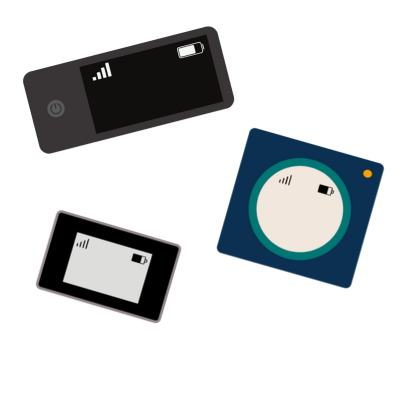 While this new generation of hotspots can do many of the things a smartphone, router, or cellular adapter can with internet connectivity, it's a jack-of-all-trades, master-of-none situation.
For example, while travel-router features in a mobile hotspot are useful, a dedicated travel router will still perform that specific role better. As mobile hotspots gain more features in common with mobile routers, such as multi-WAN, nomads who need robust connectivity will likely still prefer a dedicated router as the central hub for a system designed to be a mobile home internet replacement.
Another big limitation that remains is data plans and getting them on mobile hotspot devices. Without more competitive, flexible, hotspot-compatible plans, even the best hardware cannot reach its full potential. Additionally, US-Based cellular carriers don't currently offer remote eSIM activation for data-only devices other than tablets, but that is likely to change in the future.
Mobile hotspots are designed to provide cellular data connections - and without adequate plans, they will continue to be left behind.
With carrier capacity expanding and all three major carriers now investing heavily in fixed-location unlimited home internet plans designed to compete with landline internet providers, it's puzzling to us that mobile hotspot data plans remain largely unattractive.
It also remains to be seen whether the bulk of the mobile hotspot market will be tied to carrier-specific models. Will these new, innovative unlocked mobile hotspots displace carrier-specific models, or will carriers continue to operate as usual by offering only devices designed for their networks?
Looking Ahead: What Might Come Next
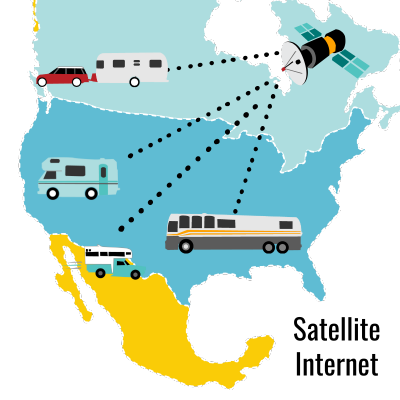 Emerging technologies should make mobile hotspots even better and more flexible options in the future. Here are several developments that could or will further reshape mobile hotspots over the next couple of years:
- Direct-to-cell and satellite integration - There is a huge investment in integrating satellite connectivity with 5G and terrestrial cellular networks. Check out our extensive satellite news coverage and our periodic industry updates for the latest. Modems with satellite support will enable future hotspots that can use both cellular and satellite services, with at least one such device already announced.
- Wi-Fi 7 and 6 GHz expansion - Wi-Fi 7 and new 6 GHz spectrum enable higher capacity and speeds to keep up with faster connections. However, current U.S. regulatory rules for 6 GHz Wi-Fi are not friendly to mobile use, especially in vehicles and outdoors. The current complex and strict regulations governing the use of the 6 GHz band for Wi-Fi limit its lawful use in common mobile internet scenarios. This is why many mobile hotspots and routers don't support the band, or only allow its use under certain restrictions, such as only after removing the battery. Fortunately, the FCC is adding new regulations to address this, which will hopefully allow mobile hotspots and routers to use 6 GHz with fewer restrictions.
- Improved modem efficiency - Continued gains in modem power and signal efficiency could extend battery life even further and continue to improve speed, reliability, and performance. More efficiency can bring more benefits beyond the obvious ones, and allow manufacturers to put more features into the compact mobile hotspot form factor.
New Mobile Hotspot Overview
Here are some of the new hotspot models where we are seeing these trends - though not all of them are available to consumers at the time of publication:
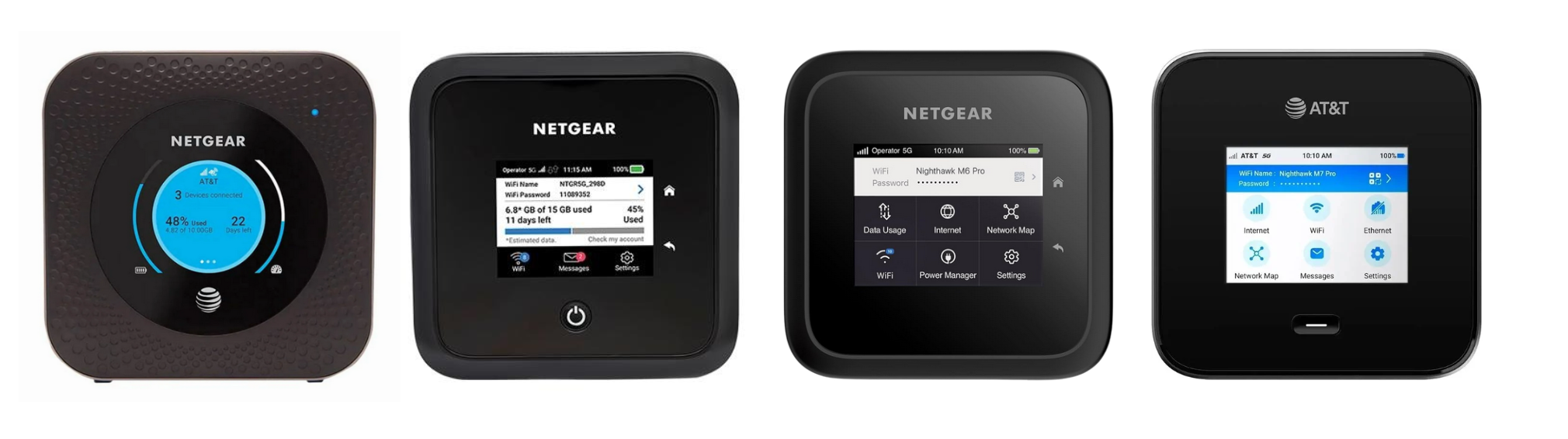
- Netgear M7 ($499) - A global mobile hotspot with an X72 modem supporting physical SIM and eSIM. Netgear offers its own eSIM marketplace plans, but also supports third-party eSIMs. Has Wi-Fi-as-WAN and an optional cradle that provides additional networking capabilities. (Our Review)
- GL.iNet Mudi 7 ($399) - Releasing in a couple of months, this mobile hotspot is a beast on paper and comes with an X72 modem supporting dual physical SIMs and eSIM, support for WAN failover, a 2.5 Gigabit Ethernet port that can also be a WAN port, separate USB-C ports for power and data, and 2x TS-9 antenna ports. (Our Overview)
- Acer Connect M6E ($299) - A ruggedized mobile hotspot with a Mediatek modem roughly at the same class as an X62/X65, supporting physical SIM, eSIM, and the vSIM provider SIMO. Supports Wi-Fi 6E, including 6 GHz, and also supports tap-to-connect for Wi-Fi. (Our Overview)
- Sonim MegaConnect ($499 - FirstNet Only) - This very rugged hotspot with an X75 modem is exclusive for FirstNet users and not available to general consumers. As a FirstNet device, it's authorized to operate at much higher power levels, features a massive 8,000 mAh battery, and includes an optional dock with an integrated antenna and cooling.
- TCL 5G Mobile WiFi P50 (No Price Yet) - Announced at CES 2026, the press release says this hotspot will support both Sub-6 and millimeter wave 5G, Wi-Fi 7, including 6 GHz, and a large battery that supports wireless charging.
- GlocalMe MeowGo G50 Max (No Price Yet) - Announced at CES 2026, not much is known about this upcoming hotspot except that it will support satellite connectivity via Skylo and claims to use AI-enabled network management to smartly switch between cellular, Wi-Fi, and satellite as needed. GlocalMe is a cloud-SIM provider brand for uCloudlink.
Mobile Hotspots: From Stagnation to Renaissance?
Dedicated mobile hotspots are no longer the obvious default they once were a decade ago, but they’re also no longer descending in relevance with boring iterative improvements.
If data plans improve alongside hardware capabilities, mobile hotspots may once again carve out a clear and valuable role in modern mobile internet setups, especially for users who prioritize portability, flexibility, and simplicity.
And for users who want a simple way to add an additional 5G connection to their existing mobile internet setup - a mobile hotspot is a great way to add more connectivity easily.
After years of incremental change, the mobile hotspot product category is showing signs of real reinvention and innovation, and it's exciting to see.
Further Reading
- Understanding & Selecting Mobile Hotspot Devices (MiFi, Jetpacks, AirCards) - Our featured guide evaluating the various ways to get online while mobile, including using mobile hotspots.
- Cellular Data Devices: Smartphone, Hotspot, Router, or Tablet? - Another featured guide covering the tradeoffs and benefits of different cellular device types.
- All About Cellular SIM Cards - Our guide covering everything about SIM cards, including explaining the differences between physical, eSIM, and vSIM.
- All Our Cellular Resources
And here is all of our recent mobile hotspot coverage:




 Mobile Internet Resource Center (dba Two Steps Beyond LLC) is founded by Chris & Cherie of