


The Wonders of MIMO
For RVers and cruisers, understanding the basics of MIMO can help you choose better cellular gear, antennas, and signal-enhancing equipment.
Modern 4G/LTE and 5G cellular radios are almost miraculous compared to earlier modems, and MIMO is a big part of why.
The first iPhone launched in 2007 using AT&T's 2G EDGE network, with cellular speeds measured in hundreds of kilobits per second.
Today, modern 5G modems have theoretical peak speeds measured in multiple gigabits per second.
Of course, theory rarely equals reality. Those peak speeds assume ideal conditions, and in the real world you share network capacity with everyone else connected to the same cell site.
Real-world cellular speeds in the hundreds of megabits per second (Mbps) are now common in good conditions, and the fastest 5G networks can reach gigabit-class speeds.
One key technology making these speeds possible is MIMO (Multiple Input, Multiple Output), an incredibly clever technique that uses multiple antennas and signal paths to increase speed, reliability, and network capacity.
MIMO is fundamental to LTE, 5G, and Wi-Fi, and it will remain a core technology as cellular networks evolve toward 6G.
MIMO is also one reason traditional cellular boosters are often less useful for modern data devices than they were in the pre-LTE era.
Read on to learn what MIMO is, how it works, and how a bit of MIMO awareness can potentially increase your cellular speeds and help you choose the right gear for your mobile internet arsenal.
If you're a member, please log in above to see your exclusive content.
Don't need a membership? Other ways you can support our work here:
-
As seen in our videos!
-
Get a FREE Month of Starlink!
And our team will get one too!
-
Get a FREE Month of T-Mobile Unlimited Data
Join the Calyx Institute, and get a bonus month - and we do too!
-
Save $20 on Visible
Verizon's prepaid phone plan, we also get a $20 credit.
-
Share About Us!
Link to our content, tell others about MIRC. It's Free!
It is with huge gratitude to our members for making the free unbiased educational content on our site possible.
Our members get exclusive access to our in-depth content, classrooms, vendor discounts (that can save you more than membership!), alerts, insider info and interactive guidance. They can even book private advising sessions.
If mobile internet is an important part of your lifestyle, consider helping make MIRC possible by joining or supporting our mission.
MIMO In A Nutshell
MIMO is a core technology behind LTE, 5G cellular, and modern Wi-Fi. It uses multiple antennas and signal paths to improve speed, stability, and efficiency.
Most modern phones, hotspots, and routers contain multiple cellular antennas to enable MIMO. On the network side, cell towers and Wi-Fi access points also use coordinated antenna arrays to communicate with devices more efficiently.
The key idea is that multiple antennas allow multiple signals and multiple signal paths. Instead of treating every reflected signal as unwanted interference, MIMO can often use those different paths to carry more data or make the connection more reliable.
For consumer cellular gear, you will most commonly see MIMO described as 2x2 or 4x4. In practical terms, 4x4 MIMO gives a modem more antenna paths to work with than 2x2 and can support more simultaneous data streams when the network and signal conditions allow it.
More MIMO capability doesn't guarantee a specific speed increase, but it gives the modem more tools to improve speed and reliability.
Modern 5G networks take MIMO even further. Cell towers can use much larger antenna arrays, often called Massive MIMO, along with beamforming to increase capacity and serve many users efficiently.
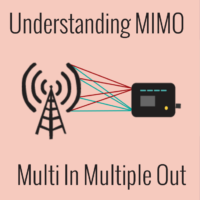
This figure illustrates a relatively simple MIMO deployment from the early days of LTE: the tower has four antennas, and the user device has two. Modern cellular towers use much larger antenna arrays, allowing the network to use beamforming and different MIMO configurations to communicate more efficiently with your device.

MIMO is a key technology that helps modern devices perform well, but there's more to MIMO than the number of antennas.
Related technologies such as spatial multiplexing, diversity, MU-MIMO, and beamforming (all explained below) help networks get more speed, reliability, and capacity out of those antennas.
MIMO is also different from carrier aggregation, another important technology commonly listed in cellular modem specifications. MIMO uses multiple antennas and signal paths to carry more data, while carrier aggregation combines multiple chunks of cellular spectrum into a larger connection. Modern modems often use both at the same time, and both can significantly impact performance.
For more on carrier aggregation and modem specifications:
Cellular Modem Specifications Guide
MIMO vs Boosters Video
Check out the video below for a quick overview of MIMO and how it compares to boosters for improving cellular performance. Although the video is a few years old, it covers the core concepts in a way that non-techies can understand:
For more on selecting cellular gear and antennas:
Cellular Data Devices - Routers & Hotspots Cellular Antennas
Member Exclusive Content Below
Member Exclusive Content In This Guide
Has this guide been helpful so far?
Well.. there's a lot more below available to our members. As well as dozens of other guides like this, videos, classrooms, forums, webinars and more. All specifically created for helping keep RVers, cruisers and nomads online.

Consider Becoming a Member
If mobile internet is an important part of your lifestyle, a membership can help keep you connected with these exclusive benefits:
- in-depth exclusive content
- interactive guidance
- vendor discounts
- alerts & insider tips
- classroom
- community
Free Content Like This Made Possible By Our Members!
We are community funded via our premium membership program - allowing us to focus on creating unbiased quality, in-depth, constantly updated content. We don't accept 3rd party advertising, we're not sponsored and we don't sell 'stuff'.
Already a member?
Log in to continue with this guide.
Check out the Topics Covered in the Member Section:
MIMO vs Cellular Boosters
We explore why cellular boosters aren't always the best for cellular signal enhancement, partly because of MIMO.
Optimizing Cellular Reception
Understanding MIMO can help you better optimize your cellular data performance. We share some info and tips for making the most of MIMO.
MIMO - Not Just For Cellular
MIMO is also used for other wireless signals, like Wi-Fi. We explain how it works with other technologies.
MIMO Deep Dive (Geek Alert)
Here, we explore MIMO in more detail and explain its key concepts and related technologies.
Conclusion: Understanding MIMO
MIMO is a critical technology for modern cellular and Wi-Fi networks. Although most of it happens automatically in the background, understanding the basics can help mobile internet users make better choices when purchasing gear, selecting antennas, and troubleshooting connections.
Moving from a single signal path to 2x2 or 4x4 MIMO can substantially improve throughput and connection stability, but the benefit depends on the network, signal conditions, and how many data streams you can actually use.
For cellular routers and hotspots with external antenna ports, a directly connected MIMO antenna is often worth considering before a booster. And if you already use a cellular booster, don't assume that stronger signal bars mean better performance.
Cellular antennas can be a vital part of your signal enhancing strategy to get a better signal, and thus better cellular data performance. They come in many shapes, sizes and varieties.
They can be used directly connected to your mobile hotspots or cellular embedded routers, or they might connect to your cellular booster. They come in omni-directional vs directional, single vs MIMO, and might support different frequency bands. They come in combination antennas with Wi-Fi and GPS.
But most importantly, is your installation options on your RV or boat.
So before choosing an antenna, be sure to understand all of these variables - and keep in mind that there likely isn't a single 'one size fits all' solution here. You may need to make compromises, or even have speciality antennas for challenging signal areas.
We recommend starting with our Guide to Selecting Antennas, and then moving on to our other guides addressing related topics:

Explore the Resource Center
Have Questions?
Join our 'Library Desk':
Internet for RVers & Cruisers Facebook Group
We cross post news articles and guides, and can help point you in the right direction to our content here on the resource center.
It is with gratitude to our premium members that we're able to offer our free content - and for that, they also have access to our member Q&A areas for more in-depth guidance.
Become a Member
 The MIA is our premium membership - designed for those who consider mobile internet an important part of their lifestyle.
In thanks for making content like this possible, we offer a bunch of additional perks. From interactive guidance, in-depth member exclusive content, discounts, alerts, classroom and ability to book private advising sessions.
Stay In the Know
We're constantly tracking the industry and analyzing new developments for mobile travelers. If you'd like to receive updates, we offer several ways:
- Subscribe to our free monthly newsletter
- Subscribe to our News Stories RSS Feed
- Subscribe to our YouTube Channel
- Follow our Facebook Page




 Mobile Internet Resource Center was founded by Chris & Cherie of