
Key Points:
- SpaceX has announced a hostile acquisition of AT&T, T-Mobile, and Verizon - combining the nation’s three major cellular carriers into X Mobile with a single consumer brand: The One Network.
- The company says the new service will unite terrestrial cellular, Starlink satellite, and AI-managed routing into a single connectivity platform.
- For RVers, cruisers, vanlifers, and other nomads - SpaceX is promising fewer dead zones, simpler plan choices, and embedded Neuralink chips for all Americans.
In our late 2025 satellite industry update on SpaceX's move to compete with cell carriers, we mentioned that Elon Musk joked at an industry summit about potentially buying Verizon to get access to more cellular spectrum.
It turns out - he was not joking.
In a surprising overnight move, SpaceX, the world's most valuable private company, executed a hostile takeover of the three major US cellular carriers: AT&T, T-Mobile, and Verizon.
This move comes after SpaceX already purchased a vast trove of cellular spectrum from the dying fourth nationwide carrier, Dish Network.
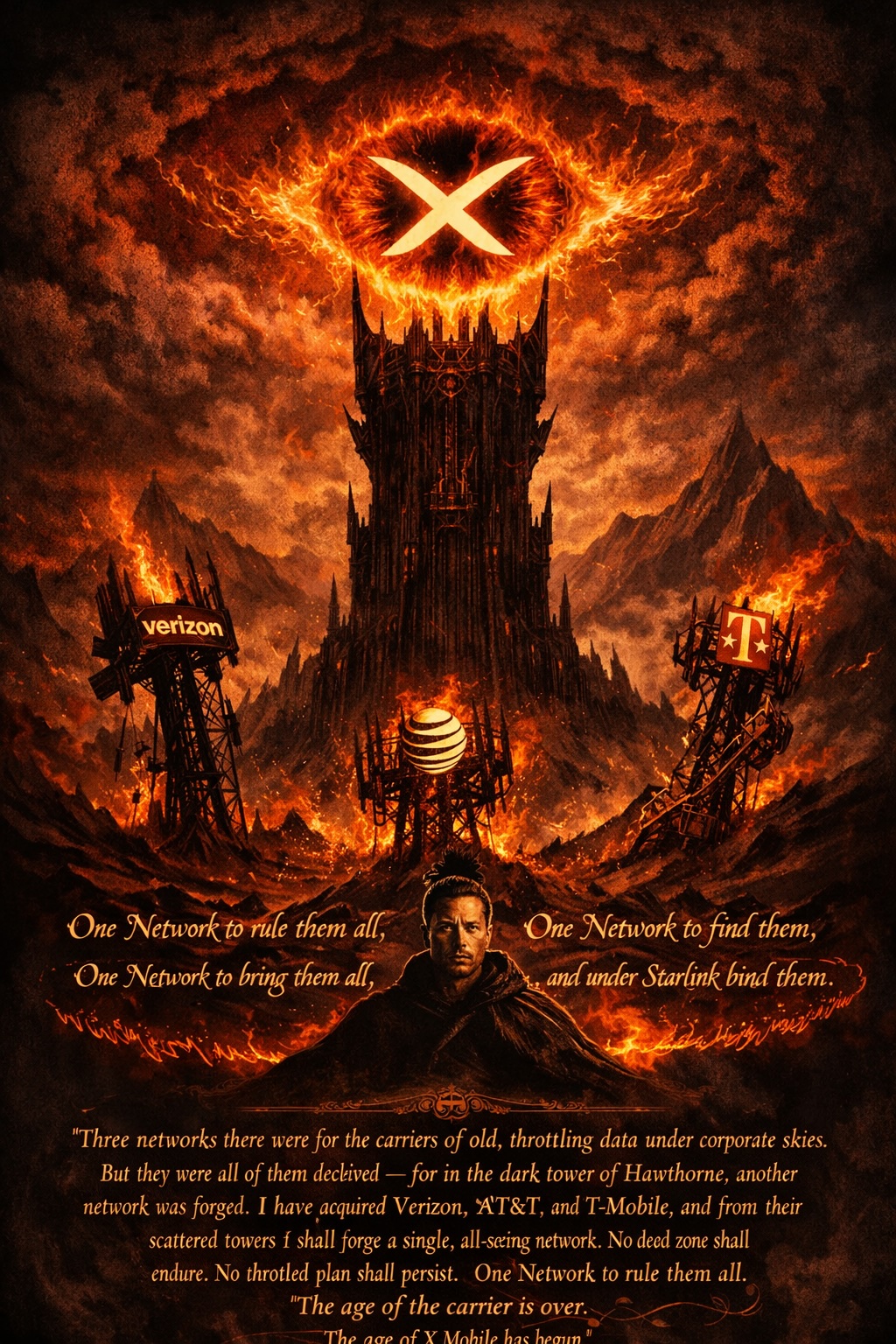
Full details of the terms of the deals aren't yet announced, but SpaceX owner and near-trillionaire Elon Musk cryptically posted on X (formerly known as Twitter) this image:
"One Network to rule them all, One Network to find them, One Network to bring them all, and under X Mobile bind them.
Three networks were the carriers of old, throttling data under corporate skies.
I have acquired Verizon, AT&T, and T-Mobile, and from their scattered towers I shall forge a single, all-seeing network. No dead zone shall endure. No throttled plan shall persist. One Network to rule them all. The age of the carrier is over. The age of X Mobile has begun."
While all the details have not come out yet, read on for what's in store for our mobile audience of nomads, RVers, and boaters...
Table of Contents
The One Network Explained
According to a pre-dawn briefing that appeared to have been assembled from equal parts investor deck, product launch, and dark prophecy - the three legacy carriers will be absorbed into a unified service under X Mobile, with a new offering known simply as The One Network.
AT&T, T-Mobile, and Verizon brands are expected to remain visible during a transition period, though insiders say they will eventually pass into history, like the kingdoms of men.
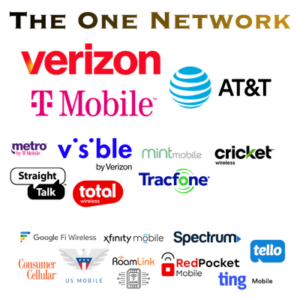 There will initially be a hierarchy of marketing sub-brands under The One Network, however:
- The Three Great Carriers - Verizon, AT&T, T-Mobile
- The Seven House Brands - Visible, Total Wireless, Straight Talk, Tracfone, Cricket Wireless, Metro by T-Mobile, Mint Mobile
- The Nine MVNOs - Google Fi Wireless, Consumer Cellular, US Mobile, Red Pocket Mobile, Tello, Ting Mobile, Spectrum Mobile, Xfinity Mobile, RoamLink
All other MVNO and reseller brands will, according to the briefing, "be cast down and forgotten."
For years, mobile users have pieced together connectivity the way the Fellowship pieced together a route through Middle-earth: carefully, nervously, and with full awareness that something would probably go wrong in the mountains.
Carrier diversity, backup SIMs, rooftop antennas, cellular boosters, Starlink terminals, and redundant routers have all been part of the strategy for those who live, work, or travel beyond easy urban coverage.
SpaceX says it intends to end that era.
The One Network intends to merge the tower assets, spectrum holdings, and subscriber bases of essentially all the major carriers, MVNOs, and resellers with Starlink’s satellite infrastructure. Rather than choosing a carrier, users would simply connect to what SpaceX calls “the best available path”: terrestrial when towers are strong, satellite when they are not, and a mysterious AI-managed handoff layer called "The Eye" whenever the company decides that it is best for you.
In principle, that could be genuinely transformative for our nomadic audience. Not all those who wander are lost, but many are currently stuck deciding whether AT&T, T-Mobile, Verizon, Starlink, or innumerable resellers and prepaid options have the least-worst signal at tonight’s campsite or anchorage.
A single network that blends all of the above could reduce the need for multi-carrier redundancy, especially for RVers, cruisers, and remote workers who constantly move between coverage areas.
 In practice, however, one does not simply merge three nationwide cellular carriers and a massive satellite broadband constellation easily.
This is where Neuralink comes in.
Neuralink AI For Seemless Connectivity
The most unsettling part of SpaceX’s briefing was a passing reference to Neuralink, Elon Musk's brain implant company, as the eventual successor to the smartphone and most cellular devices.
Rather than carrying a phone, hotspot, or tablet, SpaceX plans to install Neuralink uplinks for all users, giving them an implanted interface that could authenticate, prioritize, and seamlessly switch between cellular towers, Wi-Fi, and Starlink satellites without the inconvenience of a physical device.
SpaceX framed this as the ultimate convenience play: no dead batteries, no lost handsets, no fumbling for signal bars or passwords, just a constant intelligent connection between user and network.

An anonymous source from inside the company joked that this would also be the final stage of the evolution of consumers-as-a-product.
If the company controls the nation’s dominant satellite system, its newly consolidated cellular infrastructure, and the interface sitting quietly inside your head, then connectivity stops being merely something you use and starts becoming something that uses you.
In that vision, the real product is no longer mobile service, but the subscriber, who is happily, efficiently, and perhaps permanently bound to the lidless Eye of The One Network.
Plan Details And Options
While the notion of a populace linked to The One Network via brain implants is certainly exciting, the mobile users in our audience want to know the truly important details:
- What will the plans be?
- What happens to legacy plans?
- Will network priority remain tied to legacy tiers?
Most importantly, will truly unlimited, unthrottled, data-only plans be forged from this new regime, or will they be cast into the fire as before, along with other cherished artifacts?
Sources suggest the company believes consumers are exhausted by the current state of the market, where plan names change every year, hotspot limits remain strangely fragile, and “unlimited” often turns out to mean “until the Eye notices.”
Musk’s post also strongly implies the company intends to position The One Network as the end of throttling, dead zones, and multi-provider complexity.
Leaked plan info suggests SpaceX may simplify the industry’s current labyrinth into four main offerings:
- Shire Plan — $65/month
- Unlimited smartphone/Neuralink data, 50GB of premium data, 50GB of hotspot, SD video streaming, and satellite fallback for messaging, maps, and emergency use only. Includes roaming in the Shire, Bree, and other low-risk territories.
- Fine print: After 50GB, data may be deprioritized when the realm is congested. Satellite use for second breakfasts, elevenses, and other non-emergency hobbit activities may be restricted.
- Ranger Plan — $95/month
- Unlimited premium smartphone/Neuralink data, 100GB of high-speed hotspot, HD video streaming, talk/text/data in Canada, Mexico, and selected kingdoms of Men, plus automatic cellular-to-satellite switching for travelers.
- Fine print: In-motion use permitted only for recognized Rangers, wandering heirs, and approved off-grid subscribers. International usage may be reduced if your journey appears too far into the Wild.
- Fellowship Plan — $145/month
- Unlimited premium data, 400GB of high-speed hotspot, 4K video streaming, expanded international roaming, bundled Starlink Roam access, and full in-motion privileges for RVers, boaters, vanlifers, and remote workers crossing mountains, deserts, forests, and the occasional Mines of Moria, thanks to GnomeLink.
- Fine print: Speeds may vary in deep ravines, cursed passes, ancient tunnels, and other shadowed lands. One plan supports up to nine companions, though only one may claim to be the rightful account owner.
- Mithril Tier — $295/month
- Top-tier plan for enterprises, creators, influencers, and other lords of the digital age. Includes fully prioritized data, 1TB of high-speed hotspot, uncapped premium video streaming, enhanced global roaming, maritime and aerial privileges, and priority uplink access before the common traffic of lesser beings.
- Fine print: Subject to fair use, lawful use, and the will of the Eye. Excessive livestreaming from volcanic regions may trigger deprioritization.
While this is leaked info, analysts have already pointed out that these plans do not live up to the promise of "No throttled plan shall persist" in Elon's announcement.
Industry And Regulator Reaction
Naturally, some industry observers are skeptical that SpaceX will secure government approval for this level of industry consolidation.
 The greatest obstacle may not be technical but political, as any merger binding together the Three Great Carriers, their lesser houses, and Starlink would normally have to pass through the stern gates of Washington. Antitrust enforcers, consumer advocates, and lesser bureaucratic wardens may yet cry that such power should not be gathered into a single hand, however well-manicured and meme-capable.
Yet early signs suggest the path may be smoother than expected.
FCC Chairman Brendan Carr, speaking from the FCC's newly built slim black office tower on Isengard Avenue in DC, is strongly supportive of the transaction. He spoke with unusual clarity, with a “freshly luminous” Neuralink implant just behind the temple, according to witnesses at the event.
In other ages, such an endorsement might have raised concern that the palantír was influencing the steward; in this one, it apparently counts as interagency coordination.
Still, the regulatory path is not assured. This transaction would place a vast share of America’s wireless infrastructure, consumer subscriber base, and satellite broadband capacity under a single corporate power. The FCC may be on board, but the DOJ and various federal agencies will almost certainly examine the proposal.
Whether they can stop it is another matter.
The beacons are lit, but it is not clear whether Gondor has jurisdiction.
Concluding Thoughts
The history of wireless consolidation suggests that whenever a company promises a simpler, more unified future, customers should prepare for fresh billing confusion, perilous account migrations, and several months of customer support that feels less like a help desk and more like a journey through the Dead Marshes.
Device compatibility remains another open question.
SpaceX says many existing phones, hotspots, and routers will continue to function, particularly those already certified on one or more of the legacy networks. But future hardware may arrive bearing a new “The One Network Certified” mark for seamless switching between tower-based and satellite connectivity, and it seems increasingly clear that the long-term road leads not to a better smartphone, but to Neuralink itself.
For boaters and rural travelers, the appeal is obvious. A network able to pass from cellular towers to low-earth-orbit satellites without manual intervention would be a meaningful leap for those crossing deserts, forests, mountain passes, coastlines, and inland waters where coverage maps have often been more legend than lore.
For now, mobile users should greet this announcement with the same mix of hope and dread that has long accompanied major telecom news. If real, it would be the biggest restructuring in the history of US mobile connectivity. It could reduce complexity, extend coverage, and reshape how nomads, travelers, and remote workers stay connected.
Or it could usher in an age in which every tower, satellite, billing portal, and support chat answers at last to the same lidless Eye.
We will continue watching for official plan details, device compatibility guidance, and confirmation of whether your grandfathered hotspot plan has been spared — or whether it, too, has passed into the West.
Celebrating April Fools - Our Past Foolish Features:




 Mobile Internet Resource Center (dba Two Steps Beyond LLC) is founded by Chris & Cherie of