
Key Points:
- The Pepwave 5G Dongle supports dual SIM + eSIM carrier flexibility
- USB-C enables plug-and-play compatibility with Peplink routers and computers, 4× external antenna ports extend cellular reach
- The 5G Dongle is priced at $399, and should be officially releasing in early March 2026.
Peplink is soon officially releasing their new Pepwave 5G Dongle, a compact single-modem device designed to add a full 5G WAN connection via Ethernet-over-USB.
The Pepwave 5G Dongle is built on a Qualcomm X62 modem and supports a wide range of global 5G and LTE bands, including sub-6 GHz 5G. The 5G Dongle will be available through Peplink-authorized resellers for $399 USD.
The official release of the 5G Dongle is expected in early March although some vendors may already be able to ship to consumers. The 5G Dongle will likely release ‘pending Verizon certification’.
You can view general information about Peplink USB cellular band support in our Peplink Cellular USB Adapter page.
Table of Contents
Pepwave 5G Dongle First Look Video
Pepwave 5G Dongle Overview
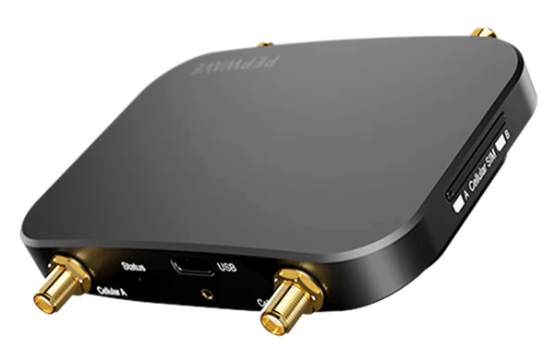
The dongle is very similar in form factor and function of Peplink's former Max Adapter devices, which were also simple modems with USB connectivity. The new Pepwave 5G Dongle supports dual physical nano-SIM slots and dual eSIMs. It ships with 1 GB of Peplink eSIM data, allowing users to test connectivity immediately out of the box without installing a SIM.
Connecting to the Device
Connectivity is provided via a single USB-C port, which connects directly to compatible Peplink routers that support USB tethering. The dongle can also be plugged directly into a laptop or computer, providing wired cellular internet access from virtually any carrier without requiring a traditional router.
Note: The Pepwave 5G Dongle does not include Wi-Fi or router functionality. It operates strictly as a wired 5G WAN device via USB-C and requires a computer or a compatible Peplink router for local networking.
The Peplink B One series routers are one of the popular consumer priced routers that the Pepwave 5G Dongle can connect to using the USB tethering port. Other Peplink routers that support USB-C WAN tethering, such as the MAX BR2 Pro, are also compatible. Even some older Peplink routers with USB tethering capabilities can support the 5G Dongle.
Signal Enhancement
Despite its compact size, the Pepwave 5G Dongle includes 4× external antenna ports, allowing it to be paired with high-gain or roof-mounted cellular antennas. This is especially important in mobile and remote environments, where signal quality often depends more on antenna placement and gain than on the modem itself.
By supporting external antennas, the dongle can be integrated into existing RV, marine, or fixed antenna setups—often delivering more stable connections and better performance than devices relying solely on internal antennas or phone-based tethering.
Common Use Cases
For mobile and remote users, the Pepwave 5G Dongle fills an important gap between traditional USB cellular modems and full-size embedded 5G routers. By presenting itself as a wired Ethernet WAN over USB-C, it avoids many of the driver, compatibility, and stability issues commonly associated with older USB modems and hotspot-based solutions, particularly when used with routers or laptops.
It also has the advantage of being a standalone device that can provide connectivity to a laptop or computer.
Admin Web Interface
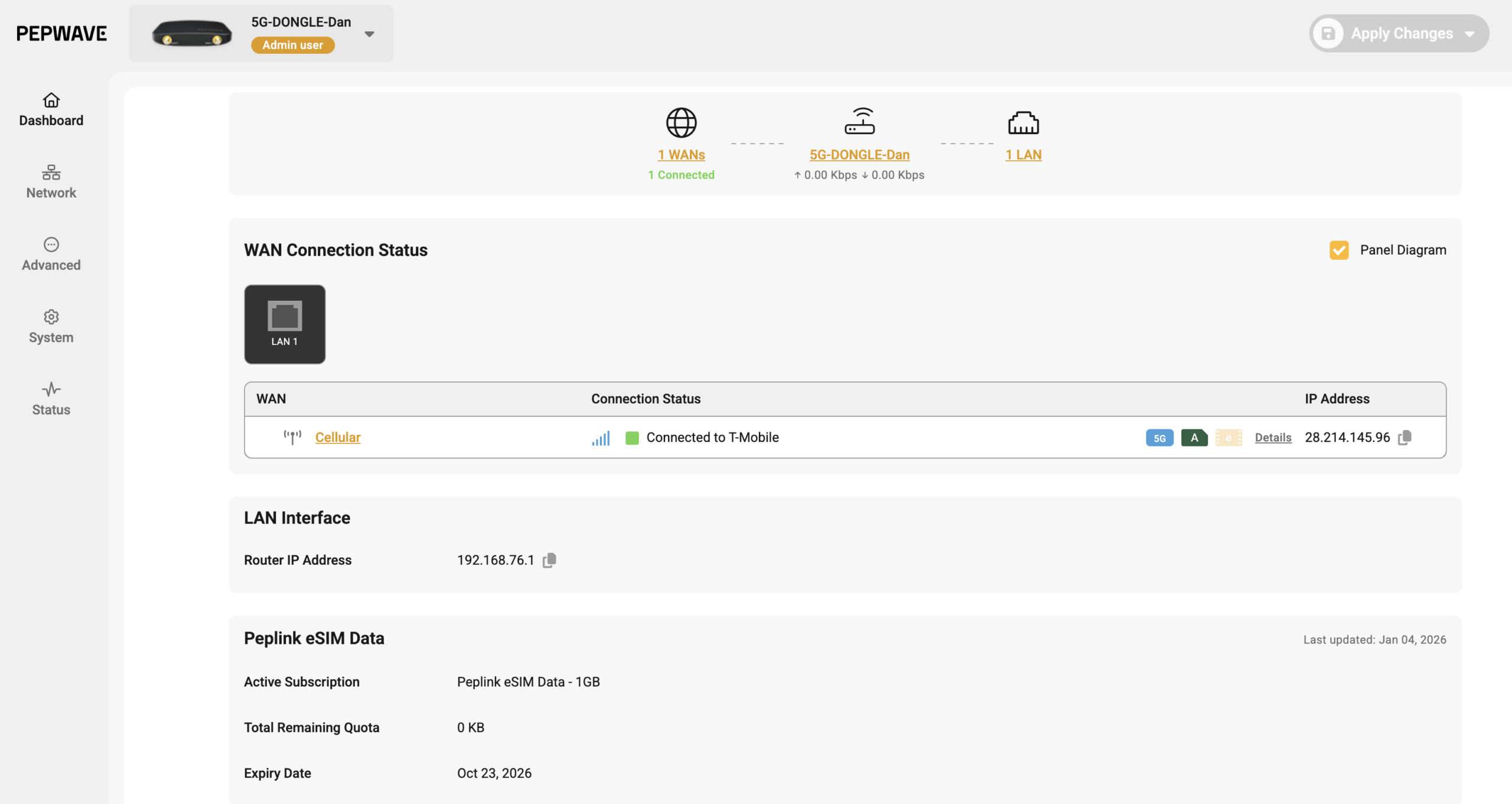
When connected directly to a computer, the Pepwave 5G Dongle offers a basic local web interface for viewing cellular status, signal metrics, and connection details. When paired with a compatible Peplink router, the dongle appears as a standard WAN interface within the router’s dashboard and can also be monitored and managed through Peplink’s InControl2 cloud management system, alongside other WAN connections.
Conclusion
Support for dual physical SIMs and eSIMs in such a compact form factor gives travelers and remote workers greater flexibility when crossing regions, switching carriers, or configuring cellular failover. When paired with external antennas, the dongle can also deliver more consistent performance than phone tethering, especially in marginal coverage areas.
For existing Peplink users, the dongle offers a straightforward way to add 5G as a primary or backup WAN connection without upgrading to a larger or more expensive router. The downside is that relatively few Peplink routers have USB-C ports.
The 5G Dongle can also provide direct internet access when plugged into a laptop, making for a portable solution for those who don't need a Wi-Fi hotspot that a mobile cellular hotspot device provides.
For more information:
Related Content at the Mobile Internet Resource Center:
- Industry Update: Late 2025 Cellular Industry Update
- Guide: Selecting Your Peplink Router
- Guide: Selecting Mobile Routers
- Gear Center: Cellular USB Adapters by Peplink
- Learning Center: Peplink for Mobile Internet
Related Updates:





 Mobile Internet Resource Center (dba Two Steps Beyond LLC) is founded by Chris & Cherie of